
Facility Management Planning for Multi-Site Operations: A Strategic Framework for Operational Excellence
INTRODUCTION
Facility Management Planning for Multi-Site Operations
Organizations operating across multiple locations face a level of operational complexity that single-site facility management models are not designed to support. As facilities expand across cities, regions, or portfolios of properties, the challenge shifts from maintaining individual buildings to coordinating assets, people, vendors, and compliance requirements at scale.
Facility management planning becomes critical in this context. Without a structured planning framework, multi-site operations often evolve in a fragmented manner—each location developing its own processes, standards, and vendor relationships. While this may appear operationally flexible, it frequently results in inconsistent service delivery, rising maintenance costs, limited asset visibility, and increased exposure to regulatory and safety risks.
In modern organizations, facilities are no longer passive physical spaces. They directly influence productivity, business continuity, operational resilience, and financial performance. Industry bodies such as the International Facility Management Association (IFMA) consistently highlight facility-related expenditure as one of the largest controllable operating costs for organizations. When multiplied across multiple sites, even minor inefficiencies can scale into significant financial and operational burdens.
This whitepaper explores facility management planning as a strategic discipline for multi-site operations. It examines why traditional site-based approaches fail at scale, outlines the structural and operational requirements of effective multi-site planning, and presents a framework that enables organizations to manage facilities as a coordinated portfolio rather than disconnected locations. The paper also outlines how Immaculate Management Group (IMG) supports organizations in designing and implementing planning models that deliver consistency, efficiency, and long-term value across multi-site environments.
Summary
Multi-site facility management is no longer a back-office operational task—it is a strategic function critical to operational efficiency, cost control, and risk mitigation. Organizations managing multiple facilities face complexities that single-site operations rarely encounter: disparate asset types, distributed teams, varying regulatory requirements, and multiple vendor relationships. Without a structured planning framework, these factors often lead to fragmented decision-making, inconsistent service delivery, and rising operational costs.
Research from the International Facility Management Association (IFMA) highlights that facilities represent one of the largest controllable operating expenses for most organizations. In multi-site operations, even small inefficiencies at individual locations can scale into significant financial and operational burdens. Similarly, Deloitte’s Global Facilities Study notes that organizations without centralized multi-site planning experience up to 25% higher operational costs and greater exposure to compliance and service risks.
This whitepaper demonstrates how structured facility management planning transforms multi-site operations from reactive and fragmented to coordinated, measurable, and strategically aligned. Key benefits include:
Operational Consistency: Standardized processes and governance across all sites
Cost Efficiency: Optimized asset lifecycles, reduced emergency maintenance, and consolidated vendor management
Risk Mitigation: Centralized compliance tracking, safety protocols, and business continuity planning
Data-Driven Decision-Making: Real-time visibility into portfolio-wide performance and KPIs
Immaculate Management Group (IMG) applies this structured, planning-first approach to help organizations align their facilities with business objectives, ensuring every location operates efficiently, reliably, and in support of long-term growth.
Why Multi-Site Facility Management Fails Without Strategic Planning
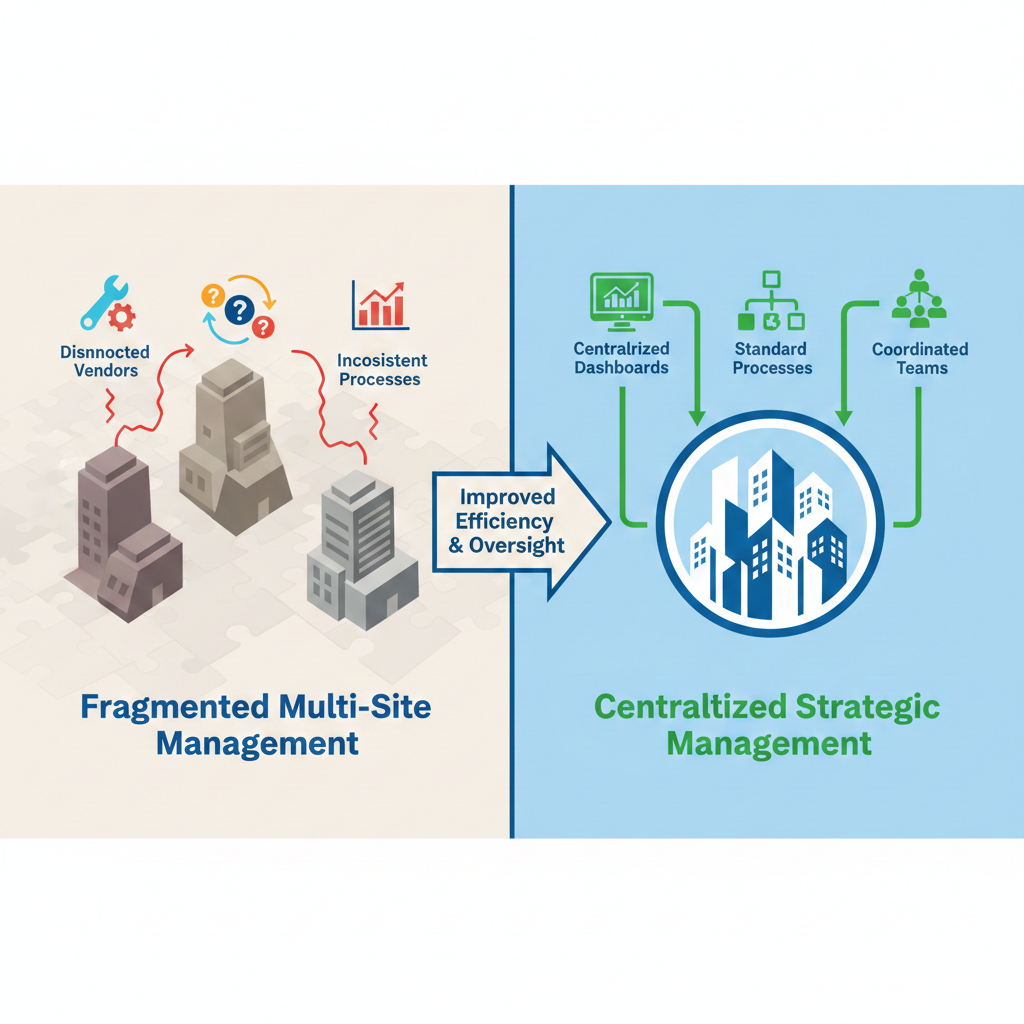
Managing multiple facilities is exponentially more complex than managing a single site. While individual buildings can be overseen through routine maintenance schedules and local decision-making, multi-site operations introduce challenges that require strategic oversight, standardization, and centralized coordination.
Key Problems in Multi-Site Facility Management
Decentralized Decision-Making
Many organizations allow individual sites to manage vendors, maintenance schedules, and compliance independently. While this may seem efficient locally, it results in inconsistent service quality, duplicative contracts, and fragmented operational oversight.Reactive Maintenance Practices
Without portfolio-level planning, facilities tend to operate reactively—fixing issues as they occur rather than preventing them. McKinsey & Company research shows that reactive maintenance environments experience up to 30% higher maintenance costs and increased downtime, impacting operational efficiency across sites.Limited Visibility and Data Gaps
Disparate reporting systems or inconsistent metrics across facilities make it difficult for leadership to accurately assess performance, forecast budgets, and make informed capital investment decisions.Unmanaged Risk Exposure
Multi-site operations often span regions with differing compliance, safety, and environmental requirements. Without centralized planning, regulatory gaps and safety risks increase, exposing the organization to financial, operational, and reputational consequences.Inefficient Vendor and Contract Management
Multiple facilities often mean multiple vendors for similar services. This fragmentation drives up costs, reduces negotiation leverage, and leads to inconsistent service delivery.The cumulative effect of these challenges is that multi-site operations become fragmented, reactive, and cost-inefficient, limiting the organization’s ability to leverage its facilities strategically.
The Hidden Cost of Poor Multi-Site FM Planning
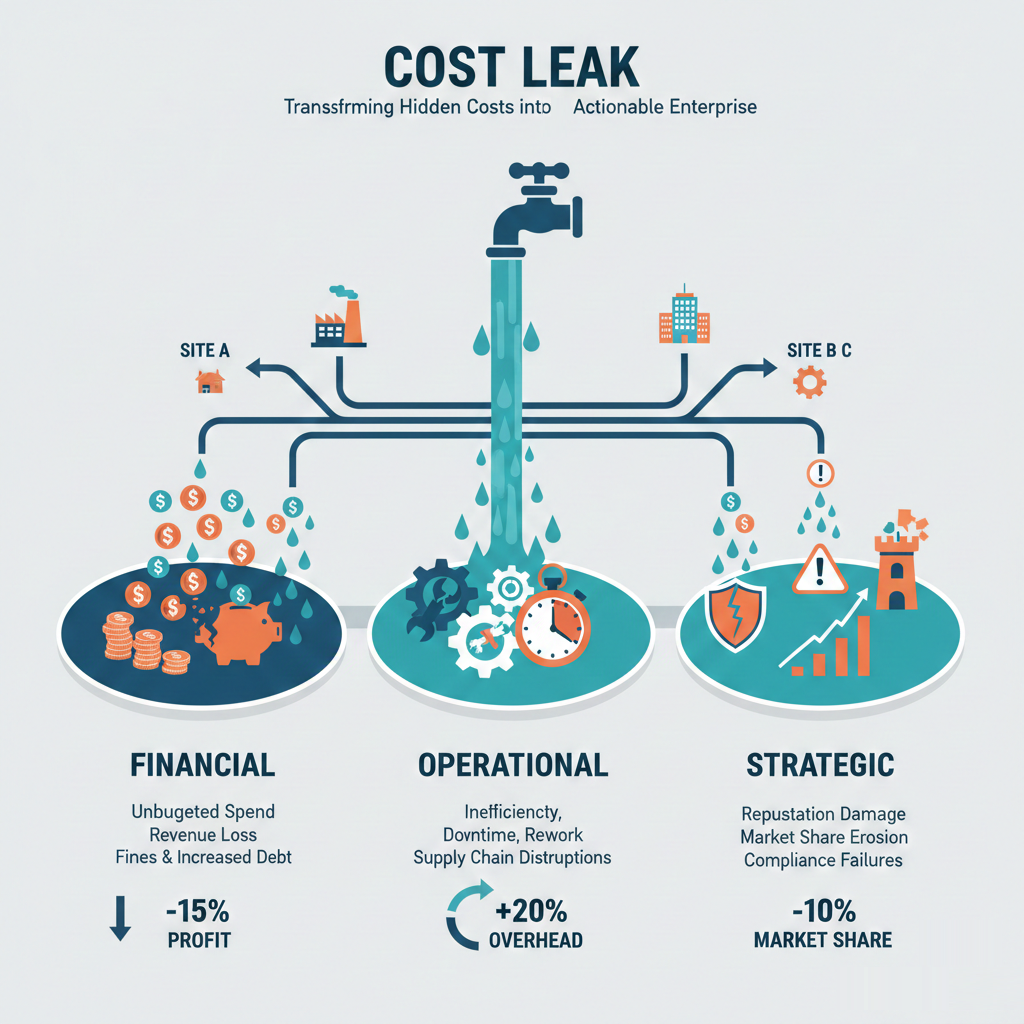
Multi-site facilities may appear to function adequately on the surface, but when planning is weak or inconsistent, costs and risks accumulate silently. Understanding these hidden costs is critical for senior decision-makers aiming to optimize operations across multiple sites.
3.1 Financial Costs
Emergency Repairs: Lack of preventive maintenance leads to expensive, unplanned repairs. According to McKinsey, reactive maintenance can be up to 30% more costly than planned interventions.
Duplicate Contracts: Different sites often engage separate vendors for the same service, inflating operational expenses unnecessarily.
Inefficient Capital Allocation: Without visibility into asset lifecycles across locations, organizations may prematurely replace equipment or under-invest in critical infrastructure, increasing long-term expenditure.
3.2 Operational Costs
Downtime and Disruption: Uncoordinated maintenance schedules across sites can disrupt operations, affecting employee productivity and service delivery.
Resource Waste: Teams spend excessive time managing local issues rather than executing strategic initiatives.
Inconsistent Service Quality: Facilities with varying standards create uneven user experiences and operational inefficiencies across the portfolio.
3.3 Strategic Costs
Risk Exposure: Gaps in compliance, safety, and environmental monitoring increase the risk of regulatory fines, legal action, and reputational damage.
Limited Decision-Making Insight: Without centralized reporting and KPIs, leadership lacks the data needed to make informed, portfolio-level decisions.
Missed Growth Opportunities: Inefficient multi-site management prevents the organization from scaling effectively and capitalizing on new locations.
By failing to address these hidden costs proactively, organizations risk transforming their facilities from strategic assets into cost centers and operational liabilities.
From Site-Based Management to Portfolio Thinking
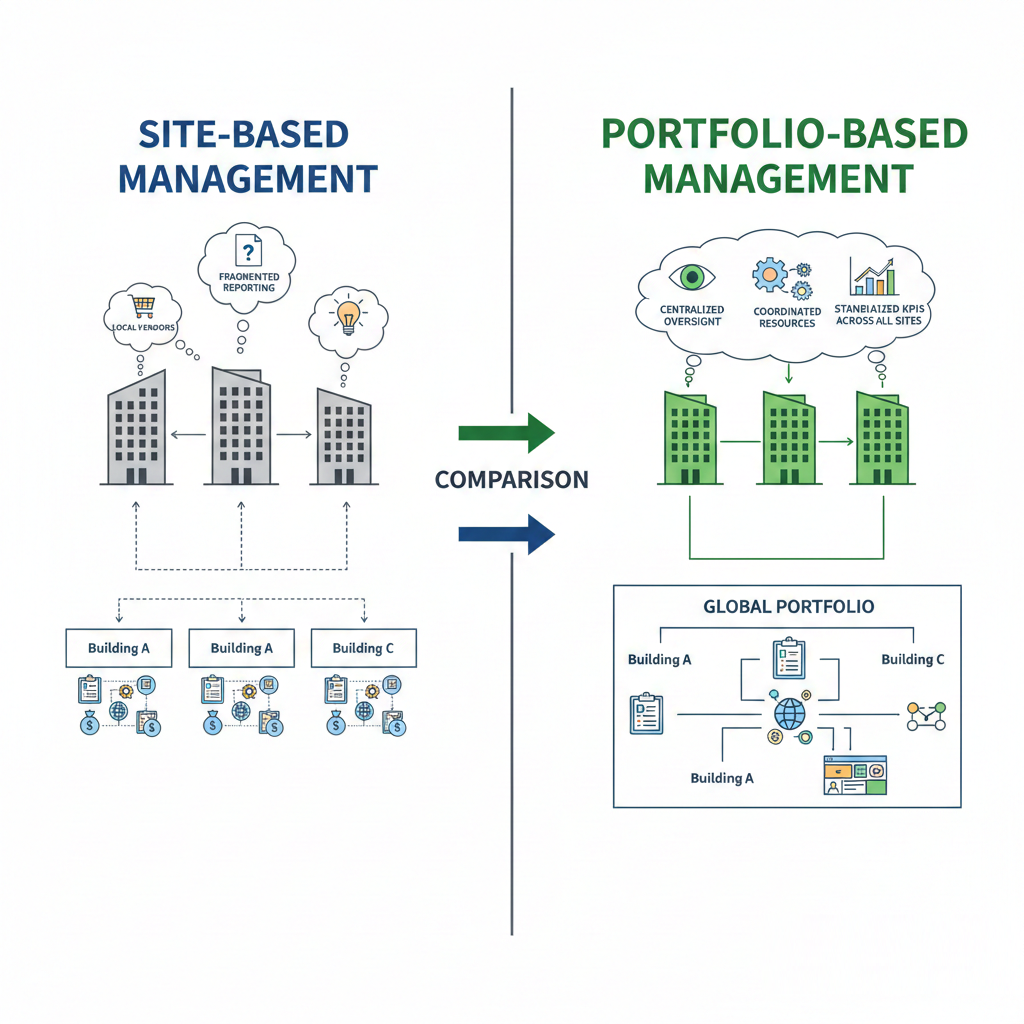
Traditional facility management often focuses on individual sites—each building managed independently with its own team, vendors, and schedules. While this approach can work for a small number of locations, it becomes inefficient and fragmented as organizations scale.
4.1 What Portfolio Thinking Means
Portfolio thinking treats multiple facilities as a cohesive, interconnected operational portfolio, rather than isolated assets. Decisions, planning, and performance monitoring occur at the portfolio level, while still allowing local execution to meet site-specific needs. This approach provides:
Centralized oversight: Leadership can see all facilities in a single dashboard, monitor performance, and identify problem areas quickly.
Standardized operations: Policies, maintenance schedules, and service levels are consistent across sites, ensuring reliability and quality.
Optimized resources: Teams, vendors, and budgets are coordinated across locations to eliminate duplication and waste.
4.2 Benefits of Portfolio-Level Management
Cost Efficiency: Consolidated procurement and standardized maintenance reduce expenses.
Operational Consistency: Uniform processes and KPIs ensure all sites meet expected performance levels.
Risk Reduction: Centralized compliance tracking and preventive maintenance minimize operational and regulatory risks.
Strategic Decision-Making: Portfolio-level data enables informed decisions for growth, capital investment, and resource allocation.
4.3 Thought Leadership Insight
According to Atkin & Brooks in total faciliies managements, organizations that implement portfolio-level planning achieve measurable improvements in cost, operational efficiency, and risk mitigation, compared to site-focused management. By viewing facilities as a strategic asset portfolio, leaders move from reactive problem-solving to proactive operational control.
Core Pillars of Multi-Site Facility Management Planning
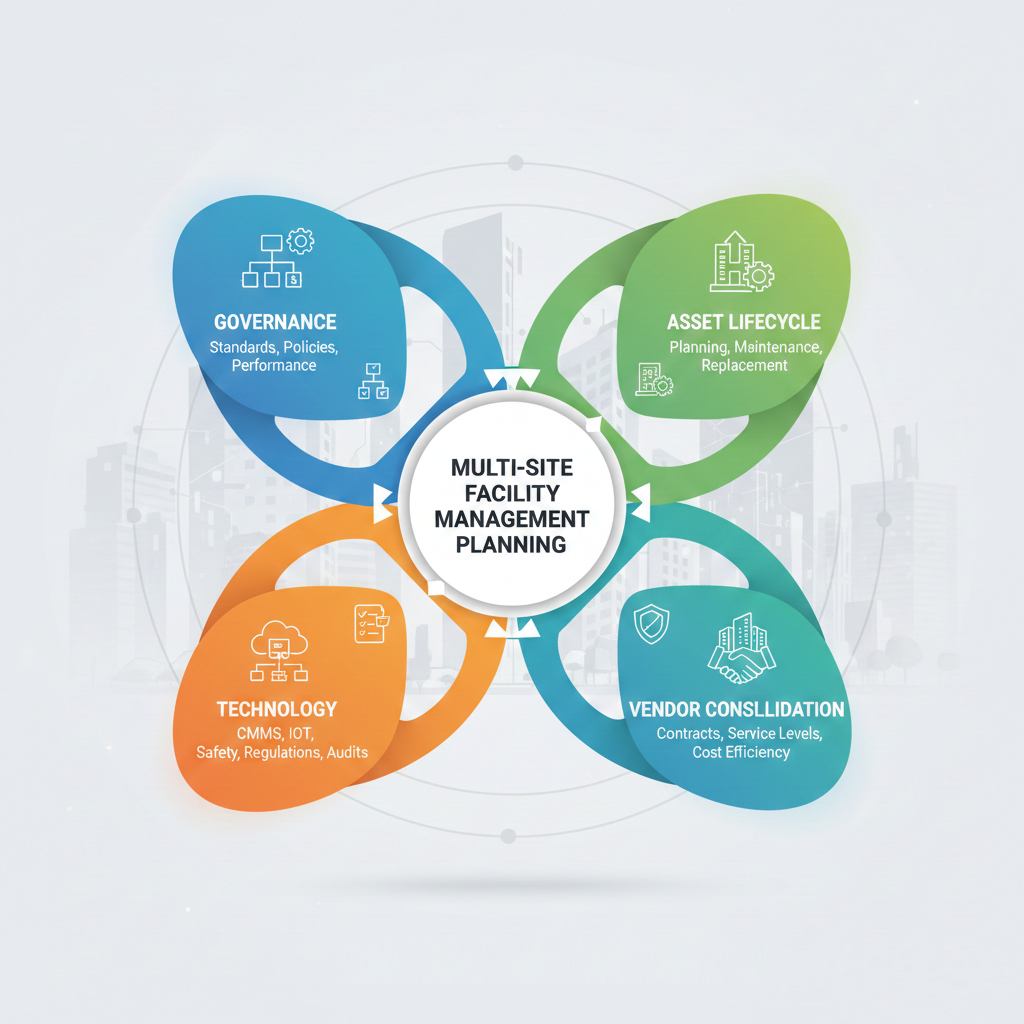
Building on the shift from site-based management to portfolio thinking, effective multi-site facility management requires a structured framework to ensure operational consistency, cost efficiency, and strategic alignment across all locations. This framework can be organized into five core pillars:
5.1 Centralized Governance & Policy Standardization
Establishing a central governance structure ensures that all sites follow consistent procedures, compliance standards, and service levels while maintaining flexibility for location-specific requirements. This reduces fragmentation, improves accountability, and ensures clear escalation pathways.
5.2 Asset Lifecycle Planning Across Locations
Portfolio-level planning tracks assets collectively across all facilities. By monitoring each asset’s age, condition, and performance, organizations can schedule preventive maintenance, optimize replacement cycles, and reduce emergency costs.
5.3 Technology Enablement & Data Visibility
Integrated technology platforms (e.g., CMMS, IWMS) provide real-time data visibility across the entire portfolio. Dashboards and predictive analytics enable proactive maintenance, performance benchmarking, and informed decision-making. Learn more about technology enablement and data visibility for multi-site facilities.
5.4 Vendor & Contract Consolidation
Coordinating vendors and contracts across multiple sites drives cost savings, reduces administrative complexity, and ensures consistent service quality. This consolidation also enhances procurement leverage and streamlines reporting.
5.5 Risk, Compliance, and Business Continuity Planning
Integrating risk management and compliance into the planning framework ensures all sites meet regulatory standards and are prepared for operational disruptions. A proactive approach reduces the likelihood of incidents and ensures rapid, coordinated response when issues arise.
The Immaculate Management Group (IMG) Approach
Immaculate Management Group (IMG) translates multi-site facility management principles into actionable, results-driven strategies that help organizations operate efficiently across all locations. By applying the five core pillars—centralized governance, asset lifecycle planning, technology enablement, vendor consolidation, and risk management—IMG ensures multi-site portfolios are managed consistently, proactively, and strategically.
How IMG Implements the Approach
Centralized Governance: IMG establishes clear SOPs, performance standards, and escalation paths, creating a single framework that all sites follow while allowing local operational flexibility.
Asset Lifecycle Management: IMG monitors asset performance across locations, schedules preventive maintenance, and plans capital replacements strategically, reducing emergency repair costs and extending asset lifespans.
Technology & Data Integration: IMG deploys integrated management systems that provide dashboards, predictive analytics, and KPIs, giving leadership real-time visibility into the portfolio’s performance.
Vendor & Contract Optimization: IMG consolidates vendors and standardizes contracts across sites to ensure quality, leverage cost efficiencies, and streamline procurement processes.
Risk & Compliance Oversight: IMG embeds risk management and compliance monitoring into every site’s operations, ensuring regulatory adherence and operational resilience.
Through this structured approach, IMG transforms multi-site facilities into strategic assets that support organizational goals, reduce costs, and improve operational consistency.
"IMG applies industry best practices to streamline governance, asset management, vendor coordination, and compliance, offering proven expertise that drives measurable results across multi-site portfolios."
KPIs That Matter in Multi-Site Facility Operations
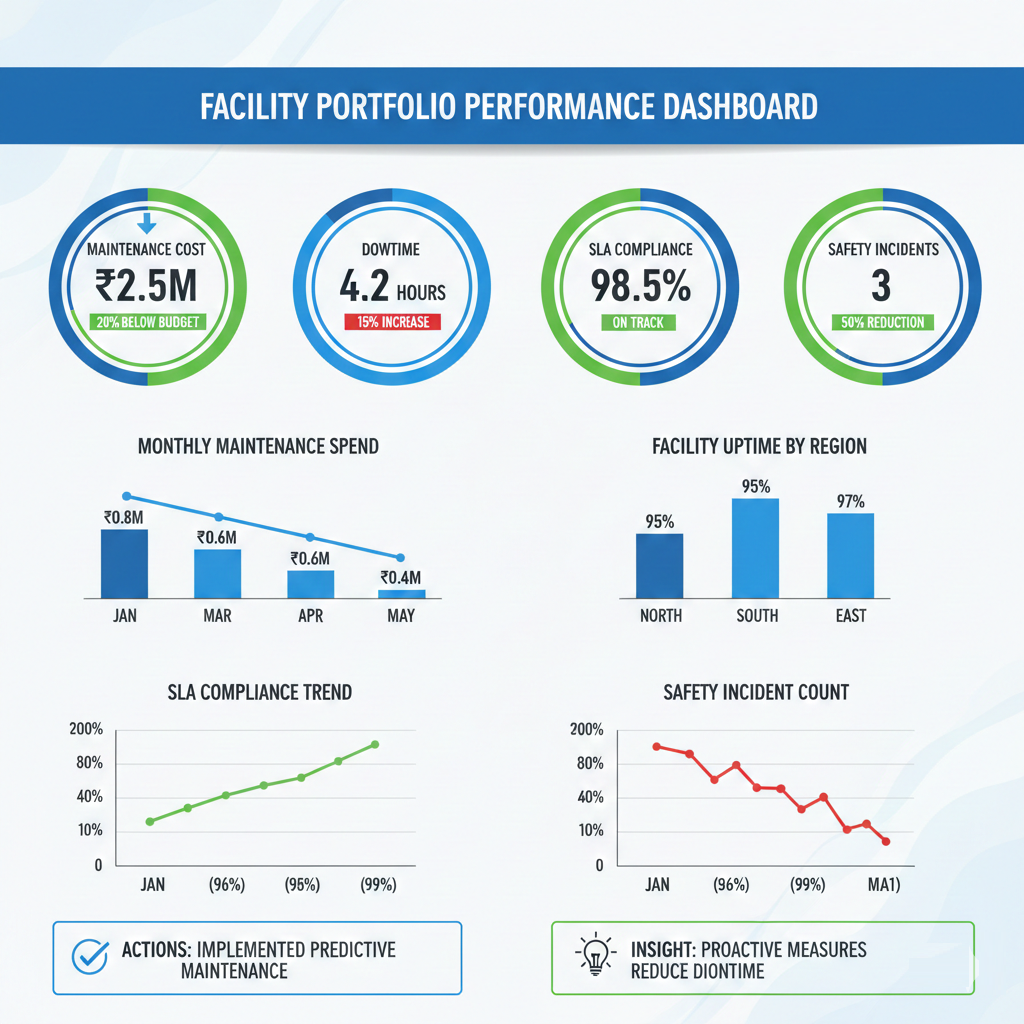
Measuring performance is critical in multi-site facility management. Without standardized KPIs, leadership lacks visibility into operational efficiency, cost management, and compliance across the portfolio. Tracking the right metrics allows organizations to make data-driven decisions, optimize resources, and maintain consistent service quality across all sites.
Key KPIs for Multi-Site Operations
Maintenance Cost per Square Foot (Portfolio-Level)
Tracks total maintenance spending relative to facility size across all sites. Enables cost benchmarking and highlights inefficiencies.Planned vs. Reactive Maintenance Ratio
Measures the proportion of preventive versus emergency maintenance. Higher planned maintenance reduces downtime and lowers costs.Asset Downtime Percentage
Monitors how often critical assets are out of service. Reducing downtime improves operational reliability and productivity.Vendor SLA Compliance
Tracks whether vendors meet agreed service levels. Ensures consistent service quality and accountability across locations.Compliance & Safety Incidents
Measures regulatory or safety violations per site. Helps reduce risk exposure and ensures all facilities adhere to standards.Energy and Resource Efficiency Metrics
Tracks energy usage, water consumption, or waste output across the portfolio, supporting sustainability initiatives and cost reduction.
Strategic Impact of Tracking KPIs
Provides a single view of performance across all sites
Enables quick identification of underperforming locations
Supports data-driven budget and capital allocation
Ensures continuous improvement and operational excellence
The Future of Multi-Site Facility Management Planning
As multi-site operations grow in complexity, facility management is evolving from a reactive, maintenance-focused function into a strategic, data-driven discipline. The future of multi-site FM planning will be shaped by technology, predictive analytics, sustainability priorities, and integrated portfolio management.
Key Trends Shaping the Future
Predictive Maintenance Powered by AI
Advanced analytics and AI enable organizations to anticipate equipment failures before they occur, reducing downtime and lowering maintenance costs.Integrated Digital Platforms
Next-generation CMMS and IWMS systems consolidate data across sites, enabling real-time monitoring, automated reporting, and portfolio-level insights.Sustainability and ESG Integration
Facility management increasingly aligns with environmental and social governance objectives. Tracking energy efficiency, waste reduction, and sustainability metrics becomes a core part of strategic planning.Centralized Risk and Compliance Management
Automation of regulatory tracking and compliance reporting allows organizations to proactively manage risk across multiple jurisdictions.Portfolio-Level Decision Intelligence
Strategic insights from portfolio data will guide capital allocation, vendor partnerships, and operational investments, turning facilities into strategic assets rather than cost centers.
Strategic Implications
Organizations that adopt these future-focused practices will gain:
Increased operational resilience and agility
Cost savings through predictive and portfolio-level planning
Enhanced sustainability performance and regulatory compliance
Strategic visibility into asset performance and business continuity
By embracing these trends, facility managers can ensure their multi-site operations are efficient, scalable, and aligned with organizational goals, positioning the portfolio for long-term success.
Book a Multi-Site Facility Strategy Consultation
Managing multiple facilities is complex, and even organizations with strong planning practices can benefit from expert guidance. Immaculate Management Group (IMG) works with multi-site operators to design and implement strategic facility management frameworks that deliver measurable efficiency, risk reduction, and operational consistency.
Why Engage IMG
Tailored Planning: IMG assesses your portfolio and creates a planning framework specific to your operational goals.
Proven Expertise: Our team applies industry best practices to streamline governance, asset management, vendor coordination, and compliance.
Data-Driven Insights: Access portfolio-level dashboards, predictive analytics, and performance metrics for informed decision-making.
Scalable Solutions: Whether managing dozens or hundreds of sites, IMG helps ensure your operations are structured, consistent, and growth-ready.
Next Steps
Book a consultation to evaluate your multi-site operations, identify gaps, and develop a roadmap for strategic facility management that aligns with your organizational objectives.
Frequently Asked Questions (FAQ): Multi-Site Facility Management Planning
1. What is multi-site facility management planning?
Multi-site facility management planning is a strategic approach to managing multiple facilities under a unified framework. It focuses on standardizing policies, optimizing asset lifecycle management, consolidating vendors, leveraging technology, and ensuring consistent performance across all locations rather than managing each site in isolation.
2. Why does multi-site facility management require a different approach than single-site management?
Single-site management often relies on localized decision-making and manual oversight. In contrast, multi-site operations introduce complexity in cost control, compliance, vendor coordination, and data visibility. Without portfolio-level planning, organizations experience inefficiencies, higher costs, and increased operational risk.
3. What are the biggest challenges in managing multiple facilities?
Common challenges include:
Inconsistent maintenance standards across locations
Limited visibility into asset performance and costs
Reactive maintenance due to poor planning
Vendor fragmentation and weak SLA enforcement
Increased compliance and safety risks
Strategic planning addresses these challenges by creating structure and accountability at scale.
4. How does technology improve multi-site facility management?
Technology platforms such as CMMS and IWMS centralize data across all locations, enabling real-time monitoring, automated reporting, predictive maintenance, and portfolio-level insights. This allows facility leaders to shift from reactive problem-solving to proactive, data-driven decision-making.
5. What KPIs should organizations track for multi-site facilities?
Key KPIs include:
Maintenance cost per square foot
Planned vs. reactive maintenance ratio
Asset downtime percentage
Vendor SLA compliance
Compliance and safety incidents
Energy and resource efficiency metrics
These KPIs provide a clear view of performance, cost control, and operational reliability across the portfolio.
6. How can organizations reduce costs across multiple facilities?
Cost reduction is achieved through:
Preventive and predictive maintenance strategies
Vendor and contract consolidation
Standardized asset lifecycle planning
Portfolio-level budgeting and capital planning
Data-driven performance benchmarking
Strategic planning ensures savings are sustainable rather than short-term fixes.
7. When should an organization consider engaging a facility management partner?
Organizations should consider engaging a strategic partner when:
Managing multiple locations with inconsistent performance
Experiencing rising maintenance or operational costs
Lacking centralized reporting and visibility
Preparing for expansion or portfolio growth
Seeking compliance, risk reduction, and operational resilience
A partner like Immaculate Management Group provides structure, expertise, and scalable solutions.
8. What makes Immaculate Management Group different in multi-site facility planning?
IMG takes a portfolio-first approach, combining governance, technology, asset planning, vendor optimization, and performance analytics into a unified strategy. Rather than managing symptoms, IMG helps organizations design long-term, scalable facility management frameworks aligned with business objectives.