
How Northeast Ohio Weather Is Increasing Facility Liability — and What Leaders Must Do Now
In Northeast Ohio, weather has always been part of facilities planning. Snowstorms, icy mornings, heavy rain, and sudden temperature drops are familiar realities for anyone responsible for managing buildings in the region. What has changed is not the presence of weather, but the risk profile it now creates for organizations.
Today’s weather patterns are more unpredictable, more intense, and more legally consequential than they were even a decade ago. Rapid freeze–thaw cycles can turn cleared walkways into ice within hours. Rain-on-snow events can overwhelm drainage systems and refreeze overnight. Heavier, wetter snowfall puts additional strain on roofs, pavement, and exterior infrastructure. These conditions do not simply create inconvenience—they create exposure.
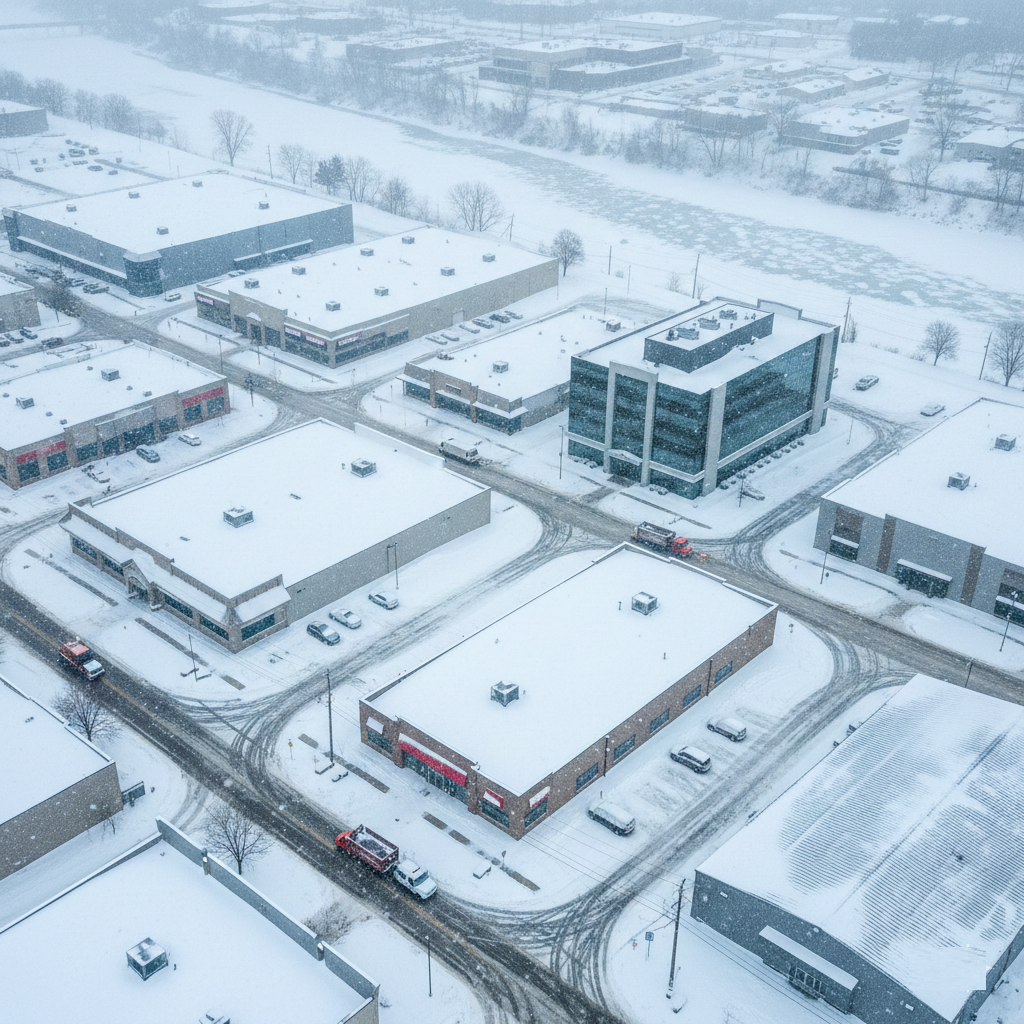
Aerial view of a snowy industrial park with multiple low-rise buildings and salted roads.
Facilities are now one of the first places where that exposure becomes visible.
Slip-and-fall incidents, vehicle damage, emergency closures, water intrusion, and unplanned maintenance costs are increasingly tied back to a single issue: whether the facility was managed proactively or reactively. For facility managers, property managers, COOs, and executive leadership, weather preparedness is no longer a seasonal operational task. It is a risk management and governance issue.
This shift has important implications. Liability is no longer determined solely by whether a surface was cleared or a service was performed. Instead, insurers, regulators, and legal teams are asking deeper questions:
Were conditions actively monitored as they changed?
Were response protocols clearly defined?
Was action taken before hazards escalated?
Can decisions be documented and defended?
In Northeast Ohio’s climate, the margin for error has narrowed. Facilities that rely on outdated, checklist-driven approaches to winter services and exterior maintenance are finding themselves exposed—even when they believe they are doing “enough.”
At the same time, organizations are under increasing pressure to control costs, operate efficiently, and maintain uninterrupted access to their buildings. This creates a tension between budget discipline and risk tolerance. When weather conditions escalate quickly, that tension often shows up in facilities first.
For today’s leaders, the challenge is clear: facilities must be managed as dynamic risk environments, not static assets. Weather readiness is no longer about reacting after conditions worsen; it is about having systems, partners, and processes in place that anticipate change and reduce liability before incidents occur.
This article explores how Northeast Ohio weather is increasing facility liability—and what leaders must do now to protect their people, their organizations, and their reputations.
Why Northeast Ohio Weather Is Different — and Getting Worse
Northeast Ohio’s weather challenges are not simply the result of cold winters. They are the product of geography, aging infrastructure, and increasingly unstable climate patterns that place unique pressure on facilities year-round.
The region’s proximity to Lake Erie plays a major role. Lake-effect snow, fluctuating moisture levels, and rapid temperature changes create conditions where weather events intensify quickly and behave unpredictably. A light snowfall can turn into heavy accumulation within hours. Rainfall can be followed by sudden temperature drops that refreeze surfaces overnight. These shifts happen faster than traditional maintenance schedules are designed to handle.
What makes this particularly risky for facilities is the frequency of freeze–thaw cycles. Instead of prolonged cold periods, Northeast Ohio often experiences repeated warming and cooling within short timeframes. This cycle causes:
Pavement to crack and heave
Water to seep into small surface imperfections and refreeze
Sidewalks and entryways to become uneven and slippery
Roof systems to weaken under repeated expansion and contraction
Over time, even well-maintained properties develop vulnerabilities that are exposed during sudden weather changes. A parking lot that appears safe in the morning can become hazardous by afternoon. A cleared walkway can refreeze after sunset. These conditions create liability windows that are easy to miss without continuous monitoring.
Another compounding factor is aging building stock. Many commercial, institutional, and multi-tenant facilities in Northeast Ohio were constructed decades ago. While these buildings may still be structurally sound, their exterior systems—drainage, roofing, concrete, and mechanical infrastructure—were not designed for today’s weather volatility. When extreme conditions meet older systems, failure points emerge quickly.
Weather-related liability is also increasing because events are less predictable. Facilities can no longer rely on seasonal norms to guide planning. Snowstorms arrive earlier or later than expected. Rainfall intensity exceeds drainage capacity. Temperature swings create ice hazards outside of traditional winter months. This unpredictability shortens response windows and increases the likelihood of incidents.
For facility leaders, the implication is significant. Planning based on historical averages is no longer sufficient. Risk management must account for:
Rapid condition changes
Multiple weather events within short periods
Infrastructure fatigue caused by repeated stress
Increased public and employee presence during hazardous conditions
Northeast Ohio weather does not simply create operational challenges—it tests the resilience of facilities systems. Organizations that continue to rely on reactive approaches are finding themselves exposed not because they failed to act, but because their systems were not built for this level of variability.
Understanding why the region’s weather is becoming more challenging is the first step. The next is recognizing how this volatility translates directly into increased liability when facilities are not prepared to respond in real time.

Close-up of cracked, frozen pavement with ice crystals filling a small pothole in winter.
How Weather Volatility Translates Into Facility Liability
Weather-related liability rarely begins with a major failure. In most cases, it starts with small, ordinary conditions that escalate faster than facilities teams expect. In Northeast Ohio, weather volatility compresses the time between safe conditions and hazardous ones, leaving little room for delayed response or assumptions.
One of the most common liability triggers is slip-and-fall incidents. These often occur not during active snowfall, but after conditions appear to have been addressed. A walkway may be cleared and treated in the morning, only to refreeze later in the day due to falling temperatures or melting snow that turns to ice overnight. From a legal perspective, the issue is not whether snow removal occurred, but whether ongoing monitoring and follow-up actions were reasonable.
Parking lots present a similar challenge. Uneven surfaces, deteriorated asphalt, and inadequate drainage allow water to pool and refreeze, creating hidden hazards. Vehicle damage, pedestrian injuries, and accessibility issues often follow. When these incidents occur, liability assessments focus on whether facility managers knew—or should have known—about the conditions and whether corrective action was timely.
Weather volatility also affects roof systems and building envelopes. Heavy, wet snow combined with freeze–thaw stress increases the risk of roof leaks, ice dams, and structural strain. Water intrusion from these failures can lead to interior damage, mold concerns, and business interruption. In these cases, liability may extend beyond physical damage to include operational disruption and health-related claims.
Another area of exposure comes from inadequate documentation. Many organizations perform maintenance and weather response activities but fail to document them consistently. In disputes with insurers or legal teams, undocumented actions may as well not have occurred. Liability increases when organizations cannot demonstrate:
When conditions were assessed
What actions were taken
Who was responsible
How frequently monitoring occurred
Weather volatility amplifies this risk because conditions change rapidly. A single log entry at the start of the day is rarely sufficient when hazards develop hours later. Without clear records, organizations struggle to defend their decisions, even when they acted in good faith.
Public-facing facilities face additional exposure. Healthcare centers, schools, retail properties, and multi-tenant buildings experience higher foot traffic and greater scrutiny. Injuries or closures in these environments escalate quickly to reputational damage, regulatory attention, and executive involvement.
Ultimately, weather volatility increases liability because it exposes gaps in systems, not intentions. Organizations that rely on static schedules, limited monitoring, or reactive vendor calls are more likely to experience incidents—not because they ignored their responsibilities, but because their approach was not designed for today’s conditions.
For facility leaders, understanding how weather volatility creates liability is critical. The next step is recognizing that reactive weather management strategies often make these risks worse, not better.
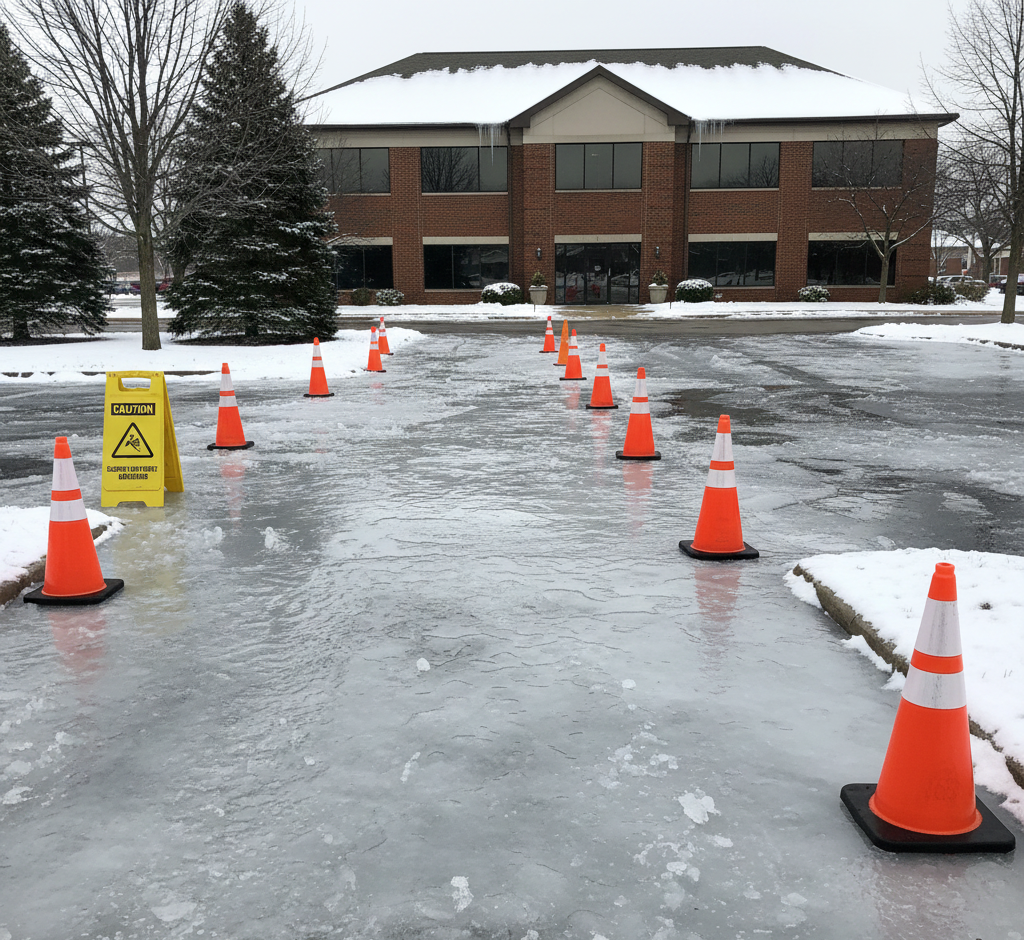
Orange safety cones block off a thick sheet of ice covering a commercial parking lot.
The Hidden Cost of Reactive Weather Management
Reactive weather management is often justified as a cost-saving approach. On the surface, it appears efficient: respond when snow falls, address issues as they arise, and avoid spending resources on conditions that may not materialize. In practice, this approach frequently leads to higher costs, greater disruption, and increased liability—especially in Northeast Ohio’s volatile climate.
One of the most immediate hidden costs is emergency response spending. When facilities rely on last-minute service calls, overtime labor, or expedited repairs, costs escalate quickly. Emergency snow removal, after-hours ice treatment, and urgent maintenance commands premium pricing, often without guaranteeing consistent results. Over the course of a season, these unplanned expenses can exceed the cost of a structured, proactive program.
Reactive management also increases operational disruption. Facilities teams pulled into constant response mode are forced to prioritize urgent issues over planned maintenance. This leads to deferred repairs, missed inspections, and overlooked vulnerabilities. Over time, small issues compound, creating a cycle where facilities are always catching up but never stabilizing.
Another overlooked cost is staff strain and burnout. Internal teams asked to monitor weather conditions, coordinate vendors, and respond to incidents on short notice often operate under sustained stress. In regions already experiencing labor shortages in facilities and skilled trades, this strain increases turnover and reduces institutional knowledge—further weakening response capability.
Insurance-related costs are another significant factor. Weather-related claims, even minor ones, can lead to:
Higher premiums
Increased deductibles
More frequent insurer audits
Tighter coverage requirements
Organizations with repeated incidents may also face difficulty defending claims if response actions are inconsistent or poorly documented. In these cases, insurers are less likely to view incidents as unavoidable and more likely to classify them as preventable losses.
Perhaps the most damaging hidden cost is reputational risk. Injuries, closures, and visible facility failures undermine trust among employees, visitors, patients, students, and tenants. In public-facing environments, a single weather-related incident can quickly escalate through social media, internal reporting channels, or regulatory scrutiny. Rebuilding confidence takes far longer—and costs far more—than preventing the incident in the first place.
Reactive strategies also create a false sense of control. Responding to visible problems can feel productive, but it often masks systemic gaps: lack of monitoring, unclear accountability, and absence of escalation protocols. These gaps remain until a major incident forces attention at the executive level.
In Northeast Ohio, where weather conditions shift rapidly, reactive management is not just inefficient—it is risky. Facilities that rely on reaction rather than anticipation are more likely to experience repeated incidents, rising costs, and increased liability.
To break this cycle, facility leaders must rethink how weather readiness is structured, measured, and supported. That shift begins with moving from reaction to proactive systems-based planning.
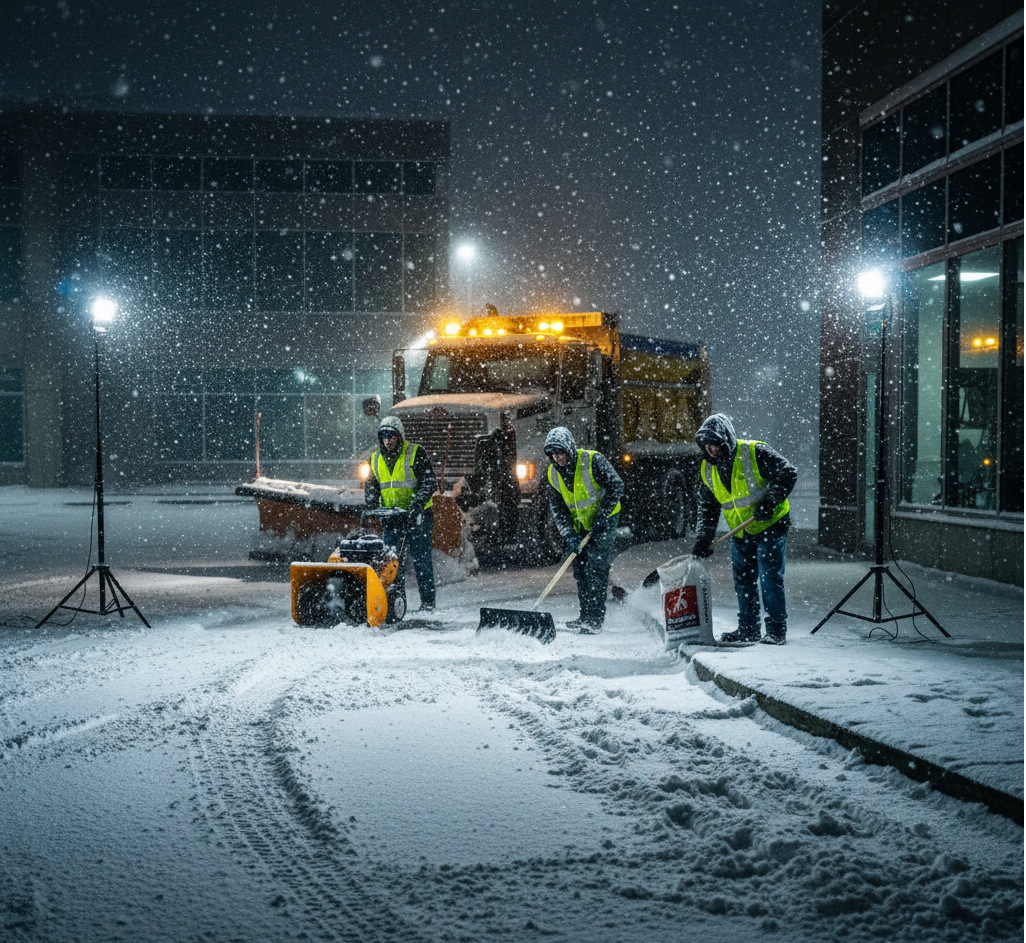
Crew clears a commercial walkway with a snowblower and shovels during a heavy nighttime snowfall.
What Proactive Weather Risk Management Looks Like in Practice
Proactive weather risk management is not about overreacting to every forecast. It is about building systems that anticipate change, reduce uncertainty, and create defensible decision-making. In Northeast Ohio’s volatile climate, this approach is becoming the standard for organizations that want to control liability rather than respond to it.
At its core, proactive weather management starts with continuous monitoring, not one-time action. Conditions in this region can change within hours, making early-morning assessments insufficient. Effective facilities programs establish monitoring intervals that align with weather volatility, ensuring that surfaces, access points, and exterior systems are evaluated as conditions evolve.
Proactivity also requires clear response protocols. Facilities teams and partners should know:
What triggers action
Who is responsible at each stage
How quickly response must occur
When escalation is required
These protocols reduce hesitation and inconsistency, two of the biggest contributors to liability exposure. When responsibilities are clearly defined, response becomes faster, more reliable, and easier to document.
Another key element is preventive exterior maintenance. Proactive organizations invest in identifying and addressing vulnerabilities before winter conditions expose them. This includes repairing cracked pavement, improving drainage, reinforcing roof systems, and correcting uneven walkways. While these actions require upfront investment, they significantly reduce the likelihood of incidents during freeze–thaw cycles.
Documentation plays a critical role in proactive risk management. Inspection logs, service records, and response reports create a clear timeline of actions taken. In the event of a claim or audit, this documentation demonstrates that the organization acted reasonably and responsibly under changing conditions. Without it, even well-executed actions can be difficult to defend.
Proactive programs also emphasize consistency over convenience. Rather than relying on ad hoc service calls, organizations establish ongoing relationships with facilities partners who understand regional weather patterns and site-specific risks. These partners do not wait for problems to appear; they monitor conditions, flag emerging issues, and recommend corrective actions.
Importantly, proactive weather management aligns facilities operations with executive priorities. By reducing incidents, stabilizing costs, and improving predictability, it supports broader organizational goals such as safety, compliance, and reputation management. Facilities become a source of confidence rather than concern.
In practice, proactive weather risk management transforms how organizations experience Northeast Ohio winters. Instead of reacting to each event, leaders operate with greater control, clearer visibility, and reduced exposure. The result is not just fewer incidents, but stronger operational resilience.
The next step for facility leaders is understanding how this proactive approach directly supports executive accountability and decision-making at the highest levels.
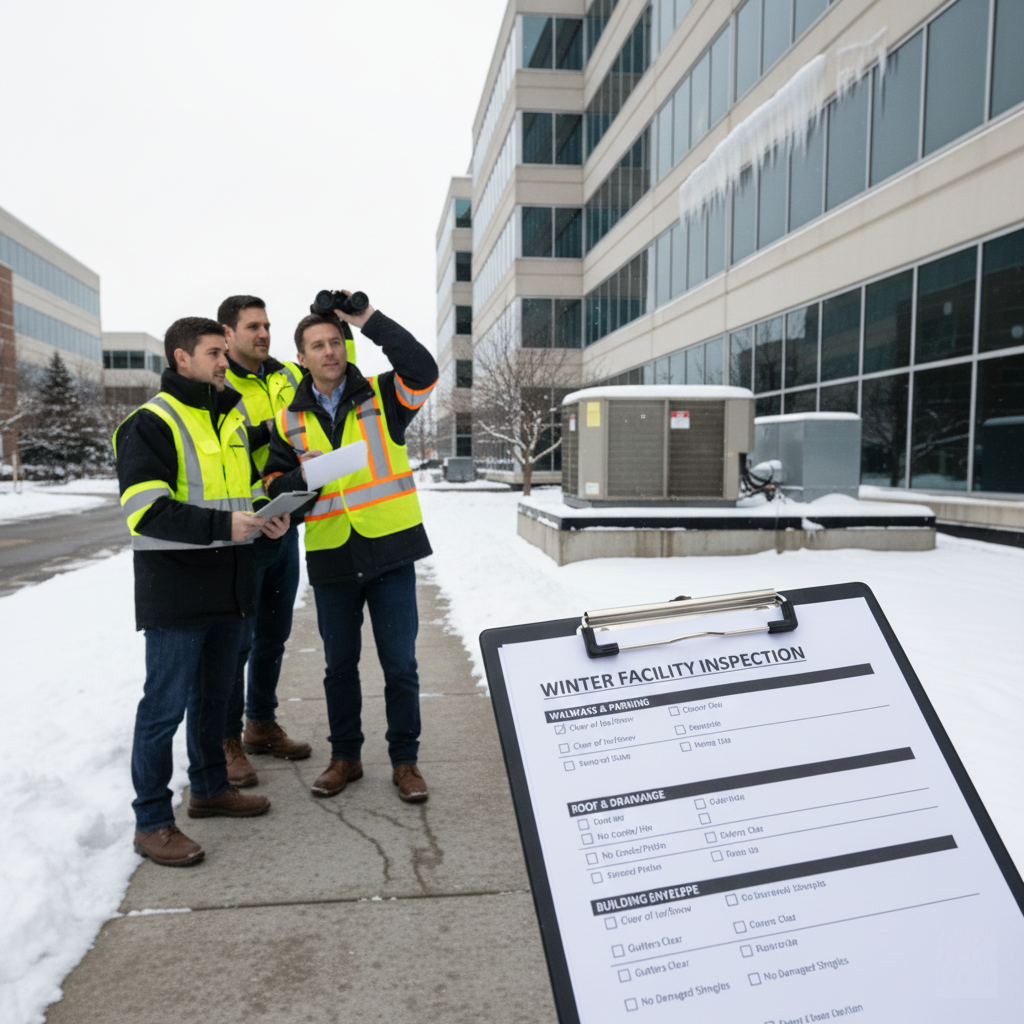
Inspectors in safety vests use binoculars and a checklist to assess a snow-covered commercial facility.
Why Weather Readiness Is Now an Executive Accountability Issue
Weather-related facility incidents no longer remain confined to operations or maintenance teams. In Northeast Ohio, the consequences of inadequate weather readiness escalate quickly—often reaching executive leadership, legal counsel, and board-level discussions within hours. This shift has made weather preparedness an issue of executive accountability, not just facilities execution.
When a weather-related incident occurs, the questions directed at leadership are immediate and direct:
Were reasonable precautions in place?
Was the organization prepared for foreseeable conditions?
Were risks identified and managed proactively?
Can leadership demonstrate oversight and due diligence?
These questions matter because they frame liability not as an operational oversight, but as a governance failure. Executives are increasingly expected to understand how facilities risks are managed, particularly when those risks affect employee safety, public access, and business continuity.
Weather readiness intersects with several executive priorities. From a financial perspective, incidents can result in unplanned costs, insurance claims, and increased premiums. From a legal standpoint, they expose the organization to litigation and regulatory scrutiny. From a reputational standpoint, they affect trust among employees, customers, patients, students, and tenants. Facilities sit at the intersection of all three.
In many organizations, the gap lies in visibility. Executives may assume weather risks are being managed without fully understanding the systems—or lack thereof—behind the scenes. When incidents occur, that lack of visibility becomes a vulnerability. Leaders are left defending decisions they did not directly make and processes they did not fully review.
This is why proactive organizations are elevating weather readiness into formal risk management discussions. Facilities leaders are increasingly asked to:
Provide clear reporting on weather preparedness plans
Demonstrate monitoring and escalation protocols
Show how vendors and partners are managed
Document compliance and response efforts
These actions create alignment between facilities operations and executive oversight. They also reduce the likelihood of surprises when conditions worsen.
Weather readiness also plays a role in organizational culture. Employees and occupants notice when facilities are consistently safe and accessible, even during adverse conditions. Conversely, repeated incidents erode confidence and create the perception that leadership is reactive or disengaged. In this sense, facilities performance becomes a visible indicator of leadership discipline.
In Northeast Ohio, where weather volatility is a known and recurring risk, executives are expected to anticipate—not excuse—its impact. Organizations that treat weather preparedness as a leadership responsibility are better positioned to manage liability, protect their reputation, and maintain operational continuity.
Understanding this executive lens is critical. The final step is recognizing how the right facilities partner can support leaders in meeting these heightened expectations.
The Role of the Right Facilities Partner in Reducing Weather-Related
As weather-related risk increases across Northeast Ohio, many organizations are discovering that internal teams alone cannot manage the complexity and pace of today’s conditions. Labor shortages, competing priorities, and limited monitoring capacity make it difficult to maintain consistent readiness without external support. This has elevated the importance of choosing the right facilities partner.
Not all service providers reduce liability. In fact, the wrong partner can increase it.
Transactional vendors focus on completing tasks when called. Facilities partners, by contrast, focus on outcomes, risk reduction, and system reliability. The distinction matters when weather conditions change rapidly and response windows are narrow.
An effective facilities partner brings regional awareness. Northeast Ohio weather behaves differently than in other parts of the country, and partners who understand local patterns are better equipped to anticipate risk. This includes recognizing when refreezing is likely, understanding how lake-effect snow impacts specific areas, and adjusting response strategies accordingly.
The right partner also prioritizes proactive monitoring. Rather than waiting for service requests, they assess conditions, flag emerging hazards, and recommend actions before incidents occur. This reduces reliance on emergency calls and helps stabilize both cost and performance.
Consistency is another critical factor. Liability often increases when service delivery is uneven—strong response one day, delayed action the next. Reliable partners establish clear schedules, escalation protocols, and quality standards that hold up even during prolonged weather events. This consistency is especially important for public-facing facilities where safety expectations are high.
Documentation is where strong partners truly differentiate themselves. Detailed service logs, inspection records, and response timelines provide the evidence organizations need to defend their decisions. When incidents occur, this documentation supports insurance claims and demonstrates due diligence. Without it, organizations are left vulnerable, regardless of effort.
A facilities partner should also integrate with leadership goals. This means communicating clearly, providing visibility into risks, and aligning services with broader objectives such as compliance, safety, and operational efficiency. Partners who understand executive priorities help facilities teams move from reaction to strategy.
In Northeast Ohio’s climate, facilities partnerships are no longer about convenience or cost alone. They are about risk transfer, reliability, and trust. Organizations that work with partners who think ahead, act consistently, and document thoroughly are far better positioned to manage weather-related liability.
This partnership model supports not only safer facilities, but stronger leadership confidence—especially when conditions are at their worst.
The final section brings these insights together and outlines what facility leaders should do now to protect their organizations moving forward.
What Facility Leaders in Northeast Ohio Must Do Now
The increasing impact of Northeast Ohio weather on facility liability leaves little room for passive decision-making. The conditions are known, the risks are documented, and expectations from insurers, regulators, and stakeholders are rising. What remains is how facility leaders respond.
The first step is acknowledging that past approaches may no longer be sufficient. Strategies built around seasonal assumptions, static schedules, or minimal documentation are misaligned with today’s volatility. Leaders must reassess whether their current systems are designed for the speed at which conditions now change.
Next is conducting a weather-focused facility risk review. This goes beyond general maintenance assessments and examines how properties perform during real-world weather events. Key questions include:
Where do water and ice accumulate first?
Which walkways, entry points, and parking areas present recurring hazards?
How quickly do teams or vendors respond when conditions change?
Is monitoring continuous or intermittent?
Can actions be clearly documented and defended?
Answering these questions provides clarity on where liability exposure exists and where proactive investment will have the greatest impact.
Facility leaders must also prioritize preventive exterior maintenance. Addressing cracked pavement, uneven surfaces, inadequate drainage, and roof vulnerabilities before winter conditions escalate reduces both incident risk and emergency costs. Preventive action is not just maintenance—it is a liability control measure.
Another critical action is strengthening communication and accountability structures. Clear protocols for monitoring, response, escalation, and documentation ensure that everyone involved understands their role. This reduces delays, eliminates guesswork, and creates consistency across sites and events.
Partner selection deserves renewed attention. Organizations should evaluate whether their current facilities partners are reactive service providers or proactive risk managers. Leaders should look for partners who understand Northeast Ohio conditions, think ahead, document thoroughly, and align with executive priorities.
Finally, facility leaders must elevate weather readiness into broader organizational conversations. Regular reporting to leadership, alignment with risk management teams, and integration with compliance efforts ensure that facilities are not operating in isolation. This visibility protects both the organization and its leaders.
Northeast Ohio weather will continue to challenge facilities. The difference moving forward will be how intentionally those challenges are managed. Organizations that act now—by strengthening systems, investing proactively, and partnering wisely—will reduce liability, stabilize operations, and protect their reputation.
For facility leaders, the path forward is clear. Weather is no longer an external inconvenience. It is a predictable risk that demands deliberate leadership.
From Weather Exposure to Operational Confidence
For facilities leaders in Northeast Ohio, the conversation about weather can no longer stop at preparation or response. The reality is clear: weather is a known, recurring risk, and how an organization manages that risk says a great deal about its operational discipline and leadership maturity.
Across this region, the facilities that experience the fewest incidents are not the ones with the biggest budgets or the newest buildings. They are the ones with intentional systems—systems that anticipate change, prioritize consistency, and make decisions that can be defended long after a storm has passed.
What Northeast Ohio weather exposes most often is not neglect, but misalignment. Misalignment between expectations and systems. Between leadership oversight and on-the-ground execution. Between reactive habits and the realities of today’s climate. When those gaps exist, liability grows quietly until an incident forces attention.
The organizations that are best positioned moving forward share several traits. They treat facilities as a strategic function, not a background service. They invest in preventive maintenance before winter magnifies weaknesses. They document actions clearly and consistently. And they work with partners who understand that reliability, attention to detail, and proactivity are not optional—they are essential.
Weather will continue to test facilities across Northeast Ohio. Freeze–thaw cycles will accelerate wear. Ice events will create sudden hazards. Heavy precipitation will strain aging infrastructure. These conditions are not anomalies; they are part of the operating environment.
The real differentiator is how leaders respond.
Facility leaders who act now—by strengthening systems, clarifying accountability, and aligning facilities strategy with executive priorities—gain more than risk reduction. They gain predictability, confidence, and trust. Facilities stop being a source of last-minute emergencies and start functioning as stable, defensible assets that support the organization’s mission.
At its core, weather readiness is about leadership under pressure. When conditions change quickly and risks rise, strong systems reveal themselves. Weak ones do too.
The choice for Northeast Ohio facility leaders is not whether weather will create challenges. It is whether those challenges will be met with reaction—or with readiness.

Exterior view of a two-story brick office building with snow-covered pine trees and parking lot.
Weather-related risk in Northeast Ohio is not a future concern—it is a current operational reality. The difference between organizations that manage it successfully and those that struggle is not luck or location. It is intentional facilities strategy.
At Immaculate Management Group (IMG), we partner with organizations that understand that facilities are more than physical assets—they are risk environments that require leadership, structure, and foresight. Our role is to help facility leaders move from reactive weather response to proactive, defensible systems that stand up under pressure.
We work alongside facility managers, property owners, and executive teams to:
Reduce weather-related liability and incident exposure
Stabilize exterior maintenance and winter operations
Strengthen documentation, monitoring, and accountability
Improve reliability across cleaning, maintenance, and site services
Support compliance, safety, and operational continuity
Our approach is built on reliability, attention to detail, proactivity, and efficiency—the principles that protect organizations when conditions are unpredictable and expectations are high.
Whether you manage a single facility or a regional portfolio, IMG helps you evaluate where weather risk exists today and what steps will make the greatest impact before the next event occurs.
The most effective time to address weather-related liability is before it becomes visible.
If your organization is reassessing winter preparedness, exterior maintenance, or facilities risk in Northeast Ohio, now is the time to act.
👉 Schedule a facilities risk conversation with IMG
👉 Connect with our team to discuss your current challenges and priorities
Because in Northeast Ohio, confidence in your facilities doesn’t come from reacting fast—it comes from being prepared first.