
How One Missed Inspection Became a Six-Figure Problem — A Scenario Every Property Owner Should Read
What follows is a scenario. The names, the building, and the specific numbers are fictional. But every element of this story—every decision, every consequence, every cost—is drawn from real patterns that play out in commercial facilities across Northeast Ohio and the rest of the country every single year.
If you manage or own commercial property, read this carefully. Because somewhere in this story, you will recognize your building.
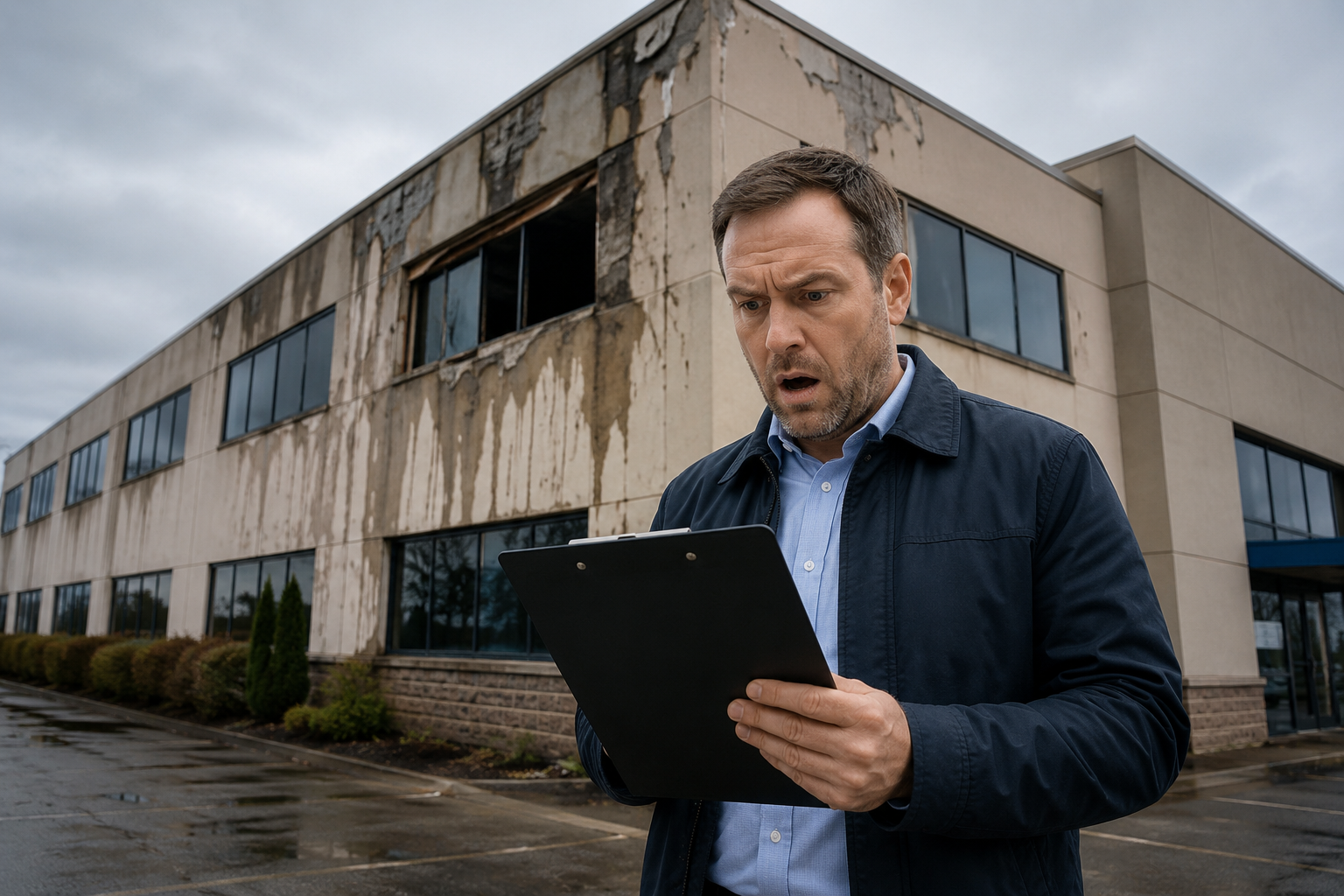
A property manager stands in a wet parking lot reading his clipboard with a shocked expression as he surveys the severe water damage and deterioration on the exterior of his commercial office building—capturing the moment a deferred maintenance problem reveals its true scale and cost.
The Building
Hartwell Commons is a three-story commercial office building in a suburban business park outside Cleveland. It was built in 1998 and fully leased to four tenants—a regional insurance firm, a healthcare staffing agency, a small law practice, and a financial planning office. The building generates approximately $420,000 in annual rental income for its owner, David, who purchased it in 2017 as a long-term investment property.
David is not a hands-on property owner. He has a demanding career, a family, and limited time to spend managing building operations. For facility management, he relies on a small local cleaning company that handles basic janitorial services three times a week. Grounds maintenance is handled by a separate landscaping contractor. There is no integrated facility management partner. There is no formal inspection program. There is no single point of accountability watching the whole building.
For the first several years of David's ownership, this arrangement worked well enough. The tenants were relatively quiet. The building was in reasonable condition when he bought it. And the cost savings from using two small independent vendors rather than a full-service facility management company added up to what felt like a meaningful annual saving.
Then came the spring of 2024.
The Inspection That Did Not Happen
Every commercial building in Northeast Ohio faces a consistent and predictable threat every spring: the aftermath of winter. Freeze-thaw cycles, ice damming, salt accumulation, and the stress of sustained cold temperatures create vulnerabilities in roofing systems, exterior surfaces, drainage infrastructure, and building envelopes that need to be identified and addressed before spring rainfall begins in earnest.
A professional facility walkthrough at the end of winter — typically conducted in late February or early March — is the mechanism by which these vulnerabilities are caught. It is not a complex or expensive process. A trained facility professional walking the building systematically, documenting what they observe, and flagging items that need attention before they become problems. For a building the size of Hartwell Commons, this walkthrough would have taken two to three hours and cost, at most, a few hundred dollars as part of a facility management engagement.
David's cleaning company did not conduct walkthroughs. That was not what they were hired to do. His landscaping contractor was not scheduled to return until April. And David himself had not visited the building since the previous October.
So the inspection did not happen.
On the roof of Hartwell Commons, concealed beneath the winter's accumulated debris and unobserved by anyone, a section of membrane roofing near the building's north parapet had developed a significant crack during the winter freeze-thaw cycles. The crack was not dramatic—perhaps eighteen inches long and narrow enough that it would have been easy to miss without a deliberate inspection. But it was deep enough to allow water infiltration when the spring rains arrived.
The spring rains arrived in early April.
The First Sign
The first indication that something was wrong at Hartwell Commons came not from David, not from his vendors, and not from a proactive inspection. It came from a tenant.
On April 14th, 2024, Karen, the office manager for the healthcare staffing agency on the building's third floor, sent David an email. The ceiling tiles in the northwest corner of their suite had developed water staining. One tile had bowed noticeably. There was a faint musty smell near the affected area.
David read the email that evening and replied that he would look into it. He called his cleaning company the next morning. They confirmed they had noticed the staining during their Tuesday visit but had not flagged it because they were not sure whether it was their responsibility to report maintenance issues. David called a local roofing company. The earliest available appointment was three weeks out.
Three weeks passed.
The Escalation
By the time the roofing contractor arrived on May 7th, what had been a localized ceiling stain had become something significantly more serious.
The roof crack had allowed water to infiltrate steadily through April, a month that brought above-average rainfall to Northeast Ohio. The water had traveled along the building's roof deck, found the path of least resistance through insulation and structural decking, and begun saturating the ceiling assembly of the third floor. By early May, the affected area had expanded from the northwest corner of the healthcare staffing suite to include the adjacent corridor and a portion of the law firm's suite on the same floor.
The roofing contractor's assessment was sobering. The crack itself — the original defect — would cost approximately $2,800 to repair. But the crack was no longer the problem. The problem was what five weeks of undetected water infiltration had done to everything the water had touched.
The ceiling assembly across approximately 600 square feet of the third floor had been saturated. The insulation was compromised. The structural decking showed early signs of deterioration. And in three locations within the affected area, visible mold growth had already begun on ceiling tiles and wall surfaces.
The roofing contractor fixed the crack. Then he handed David a referral to a water damage remediation company and told him he needed to call them before he did anything else.
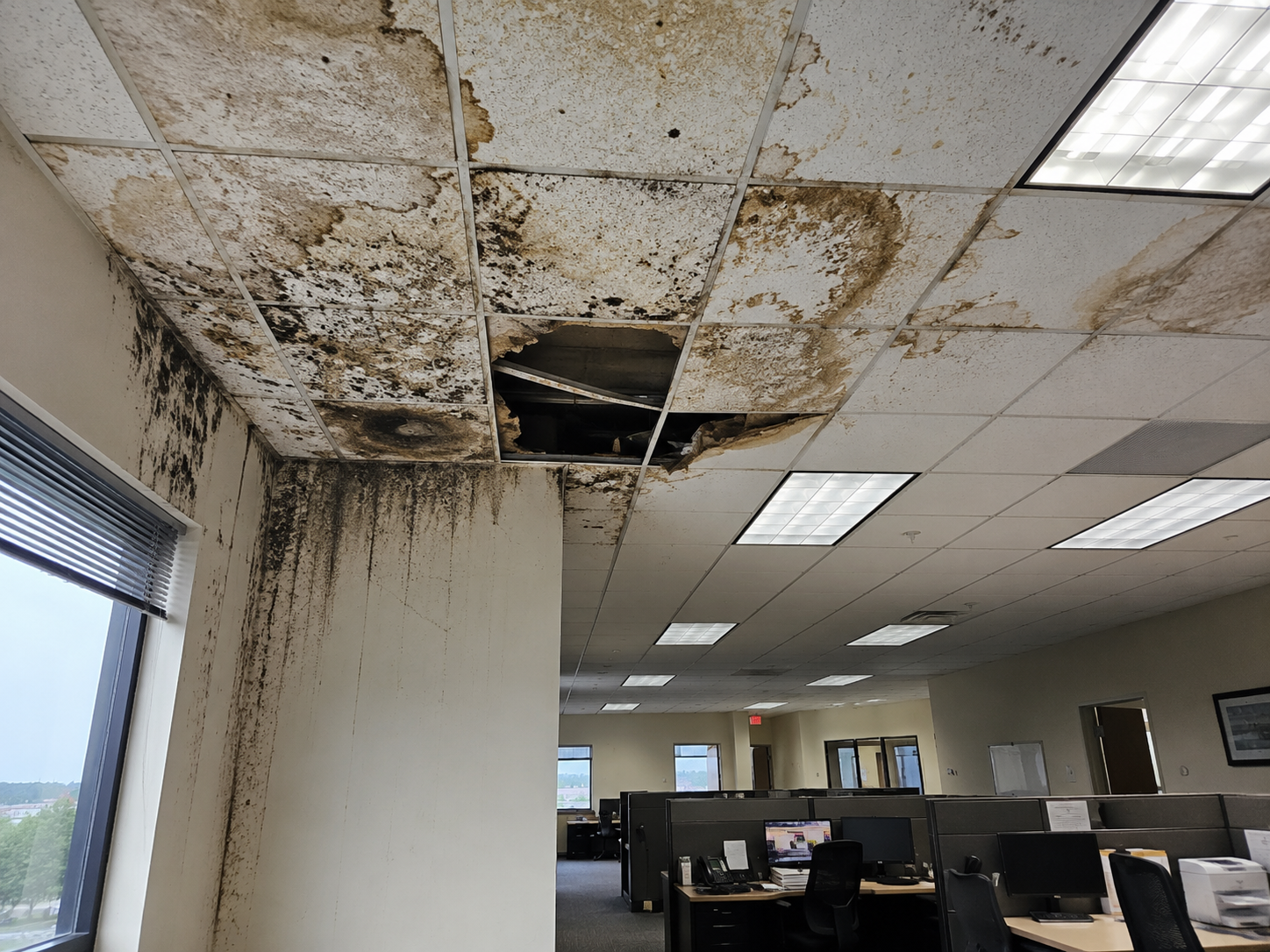
Severe water damage and extensive black mold growth across multiple ceiling tiles in a commercial office space — one tile completely collapsed exposing the structural ceiling above, with mold streaking down the wall column. Office cubicles and workstations visible below illustrate the disruption to the tenant's operations and the significant remediation costs this level of damage generates.
The Remediation
The water damage remediation company arrived for their assessment on May 9th. Their report, delivered two days later, outlined the scope of what needed to happen before the building could be considered safe and before any reconstruction could begin.
The affected ceiling assembly across 600 square feet needed to be fully removed and disposed of as contaminated material. The structural decking needed to be inspected, treated, and, in two locations, replaced. The mold-affected areas required professional remediation—containment, removal, treatment, and clearance testing—before the space could be reoccupied. All affected materials needed to be handled as regulated waste.
The remediation scope alone—before a single new ceiling tile was installed or a square foot of carpet was replaced—came to $47,000.
David approved the work. He had no choice. The alternative was allowing tenants to occupy a space with active mold growth, which carried regulatory consequences and liability exposure that he could not afford.
The remediation took three weeks. During that period, the healthcare staffing agency—whose suite was at the center of the affected area—could not fully occupy their space. They relocated their staff to a combination of remote work and temporary office space at a cost that they documented carefully and presented to David as a claim against his property.
Their documented disruption costs came to $18,500.
The Reconstruction
With remediation complete, the building needed to be put back together. The reconstruction scope included new ceiling assemblies across 600 square feet, replacement of damaged flooring in two areas where water had reached the subfloor, repainting of affected wall surfaces, and replacement of two damaged light fixtures.
The reconstruction contractor's quote: $34,000.
David approved it. The work took two weeks. The building's third floor was fully out of service during this period, affecting both the healthcare staffing agency and the law firm whose suite had been partially affected. The law firm documented their disruption—meetings rescheduled, clients inconvenienced, temporary arrangements made—and submitted a claim of $9,200.
Total reconstruction cost: $34,000. Total tenant disruption claims: $27,700.
The Insurance Conversation
David had property insurance. He filed a claim covering the remediation and reconstruction costs — a total of $81,000. His insurer processed the claim and then had a conversation with David that he had not anticipated.
The insurer's adjuster noted that the water damage resulted from a roof defect that had been present and visible for some time before the damage occurred. They asked David when the roof had last been professionally inspected. David could not produce documentation of any inspection during his ownership of the building. They asked whether he had a regular facility maintenance program in place. He described his cleaning and landscaping arrangements. The adjuster noted that these did not constitute a facility maintenance program for a commercial building of this type.
The insurer paid the claim—but informed David that his policy would be reviewed at renewal. When renewal came in August 2024, his annual premium increased by $14,400. The insurer also added a clause requiring documented annual roof inspections as a condition of continued coverage.
The premium increase alone — in the first year — added $14,400 to the cost of the original missed inspection.
The Tenant Conversation
In June 2024, as the reconstruction was being completed, David received a letter from the attorney representing the healthcare staffing agency. The letter outlined their position on the lease renewal conversation that was scheduled for August — when their three-year lease was set to expire.
They were not renewing.
The letter was professionally worded. It cited the disruption to their operations, the impact on their staff, and their concerns about the building's maintenance standards going forward. It did not say that the water damage event was the sole reason for their decision not to renew. But it made clear that it was a significant factor.
The healthcare staffing agency had been paying $8,500 per month in rent — $102,000 per year. They vacated in September 2024.
David listed the space immediately. In the Northeast Ohio suburban office market, finding a replacement tenant for 3,200 square feet of third-floor commercial space takes time. David's broker estimated six to nine months to lease up, with a tenant improvement allowance likely required to attract a new tenant.
The vacancy period cost David $51,000 in lost rent over six months. The tenant improvement allowance for the new tenant came to $28,000. Leasing commissions were $9,500.
Total tenant loss cost: $88,500.
The Final Accounting
Let us add up what the missed spring inspection cost David at Hartwell Commons.
Remediation: $47,000 Reconstruction: $34,000 Tenant disruption claims: $27,700 Insurance premium increase (year one): $14,400 Lost rent during vacancy: $51,000 Tenant improvement allowance: $28,000 Leasing commissions: $9,500
Total: $211,600
Against this, consider what a professional spring facility walkthrough would have cost. As part of a full-service facility management engagement for a building the size of Hartwell Commons, the spring inspection is not a separate line item—it is part of the service. But if priced independently, a thorough professional walkthrough with a written report and documented findings would cost, at most, $500 to $800.
The roof crack that caused all of this would have been identified. A repair would have been scheduled. The $2,800 fix would have happened in March rather than May. And none of the $211,600 in downstream costs would have occurred.
A $500 inspection prevented — or rather, failed to prevent — a $211,600 problem.

An Immaculate Management Group facility professional conducts a thorough roof inspection on a commercial building—crouching at the parapet edge, examining the roof membrane carefully while documenting findings on a tablet. This is the proactive inspection that catches the crack before the rain arrives—and prevents the six-figure problem before it begins.
What Would Have Been Different
This scenario does not require a sophisticated analysis to understand. The causal chain from missed inspection to six-figure loss is direct and linear. Every step in the escalation was predictable and preventable.
A facility management partner watching Hartwell Commons would have conducted the spring walkthrough as a matter of routine. They would have documented the roof membrane crack. They would have flagged it to David with a recommended repair timeline and cost estimate. David would have approved a $2,800 repair. The roofer would have come in March. The crack would have been sealed before the April rains arrived.
Karen would never have sent that email. The ceiling tiles would never have stained. The mold would never have grown. The remediation would never have happened. The tenants would not have been disrupted. The insurance claim would never have been filed. The premium would not have increased. And the healthcare staffing agency—satisfied with a well-maintained building—would in all probability have renewed their lease.
$211,600 in losses. Prevented by a routine inspection that would have cost less than $1,000.
This is not a story about bad luck. It is a story about the predictable financial consequences of operating a commercial building without the systems, the expertise, and the proactive attention that professional facility management provides.
The Pattern Repeats
The details of David's story are specific to Hartwell Commons. But the pattern is not. Across commercial properties in Northeast Ohio and beyond, versions of this scenario play out every year—in buildings where facility management is treated as a cost to minimize rather than a system to invest in.
The specific trigger changes. Sometimes it is a roof. Sometimes it is a plumbing system that was not properly maintained and fails catastrophically. Sometimes it is a drainage system that was not cleared before winter and causes flooding in the spring. Sometimes it is an HVAC system that was not serviced and fails during a July heat wave, triggering tenant disruption and emergency repair costs that compound through the summer.
The mechanism is always the same. A known and manageable condition goes unobserved because no one is systematically watching the building. The condition worsens. A triggering event—rain, heat, cold, or time—converts the latent condition into an active problem. By the time the problem is visible, it has already become expensive. The costs cascade.
The commercial properties that avoid this pattern are not the ones that get lucky. They are the ones where someone is consistently watching, systematically documenting, and proactively addressing what they find—before the rain comes, before the heat arrives, before the trigger event converts a manageable condition into a six-figure problem.
What This Means for Your Building
If you manage or own commercial property in Northeast Ohio, the honest question this scenario raises is a simple one: who is watching your building?
Not cleaning it. Not cutting the grass. Watching it systematically and professionally, with the training and the accountability to identify what needs attention before it becomes expensive.
If you cannot answer that question with a specific name and a specific process, your building is carrying the same kind of latent risk that David's building carried in the winter of 2024. The crack in the membrane may not be there yet. Or it may be. Without a systematic inspection program, the honest answer is that you do not know.
The cost of not knowing — as David discovered, can be very high.
Immaculate Management Group is a full-service facility management contractor based in Northeast Ohio, providing commercial cleaning, landscaping, painting, pest control, project management, and transportation services to world-class commercial facilities. MBE/EDGE Certified. To speak with our team about your facility needs, contact us at info@theimggroup.comor call 440-833-4258.