
What Insurance Companies Look for When They Walk Through a Commercial Property

Most commercial property owners think about insurance at two specific moments: when they are purchasing a policy and when they are filing a claim. Everything that happens in between — the years of building operations, maintenance decisions, and facility management choices — tends to feel disconnected from the insurance relationship.
It is not.
Insurance companies understand commercial properties in a way that most property owners do not fully appreciate. When an insurer sends an inspector to walk your building — which they do at policy inception, at renewal, and following any significant claim — they are not conducting a courtesy visit. They are performing a structured risk assessment that directly determines your coverage eligibility, your premium, and the conditions attached to your policy.
What they find during that walkthrough has financial consequences that extend far beyond the inspection itself. Properties that pass a commercial insurance inspection with minimal findings enjoy lower premiums, broader coverage, and fewer restrictive conditions. Properties that generate significant findings face premium increases, coverage restrictions, policy conditions requiring remediation within defined timeframes, and in some cases, non-renewal.
Understanding exactly what insurance inspectors look for — and ensuring your building meets those expectations before an inspector arrives — is one of the most financially practical things a commercial property owner or manager can do. This post gives you that understanding.
Why Commercial Property Insurance Inspections Happen
Commercial property insurance is fundamentally a risk transfer arrangement. The insurer agrees to bear financial losses that occur at your property in exchange for a premium that reflects the probability and potential magnitude of those losses. The inspection process is how the insurer assesses that probability.
Unlike residential property insurance — where underwriting is often based primarily on property characteristics and location data — commercial property insurance involves active, ongoing assessment of how the property is being managed. Insurers know from decades of claims data that the condition and management quality of a commercial property is one of the strongest predictors of future loss events. A well-maintained, professionally managed commercial building generates fewer claims than a poorly maintained one — and when claims do occur, they tend to be smaller and more contained.
This is why commercial property insurers invest in inspection programs. They are not looking for reasons to deny coverage. They are looking for an accurate picture of the risk they are being asked to insure — and they are looking for evidence that the property owner is managing that risk responsibly.
For commercial property owners, understanding the inspection process from the insurer's perspective transforms what might feel like an intrusive compliance exercise into a practical opportunity. A building that is proactively managed to meet insurance inspection standards is a building that is also being managed to minimize the actual risk events that inspections are designed to identify.
The Eight Things Insurance Inspectors Look for Most Carefully
1. Roof Condition and Maintenance History
The roof is consistently the first and most carefully examined element of any commercial property insurance inspection — and for good reason. Roof-related water damage is among the most common and most costly categories of commercial property insurance claims. A well-maintained roof in good condition represents manageable risk. A roof with deferred maintenance, unaddressed damage, or inadequate drainage represents the kind of risk that drives claim frequency and severity.
Inspectors will look at the visible condition of the roof membrane, flashings, parapets, and drainage systems. They will note any visible damage, ponding water areas, debris accumulation, or signs of previous patching. They will ask about the age of the roof and when it was last professionally inspected. They will look for documentation of regular maintenance and any repairs that have been performed.
A roof that is aging but well-maintained and regularly inspected is a manageable risk. A roof that is aging with no documented inspection history and visible deferred maintenance is a significant concern — one that can trigger a requirement for a third-party roof inspection, a coverage restriction on roof-related claims, or a policy condition requiring documented repairs within a specified timeframe.
What helps: maintaining documented records of annual roof inspections, addressing flagged items promptly, and having a recent professional inspection report available when the insurer's inspector arrives.
2. Exterior Building Condition
The condition of the building's exterior — walls, windows, doors, sealants, caulking, and foundation — is the second major focus of a commercial property insurance inspection.
Inspectors are looking for signs of water infiltration, structural deterioration, deferred maintenance, and unaddressed damage. Peeling paint on concrete or masonry surfaces can indicate moisture issues beneath the surface. Failed sealant around windows and penetrations creates water infiltration pathways. Cracks in exterior walls — depending on their location, orientation, and width — can indicate structural movement that needs professional assessment. Damaged or deteriorated entrance systems create both water infiltration risk and security vulnerabilities.
Each of these conditions represents a potential claim in the insurer's risk model. A building exterior that is clean, well-maintained, and free of obvious deferred maintenance signals a property management approach that reduces risk. A building exterior with multiple visible maintenance deficiencies signals the opposite.
What helps: regular exterior cleaning and inspection, prompt attention to caulking and sealant failures, and addressing visible exterior damage before it becomes a larger structural issue.
3. Electrical Systems and Fire Risk
Electrical system condition is a critical focus of commercial property insurance inspections because electrical failures are a leading cause of commercial building fires — one of the highest-severity claim categories in commercial property insurance.
Inspectors will look at the condition of electrical panels, the age and type of wiring where visible, the condition of electrical rooms and equipment areas, and the presence and condition of fire suppression and detection systems. They will note any visible electrical hazards — exposed wiring, overloaded panels, improper modifications — and will ask about the maintenance history of fire suppression systems and the date of the most recent fire alarm inspection.
The presence of documented, current fire system inspection certificates — from a licensed fire protection contractor — is one of the most specific items inspectors look for and one of the most common findings when property owners have not maintained their compliance records. In most jurisdictions, annual fire system inspections are legally required. Insurance inspectors treat missing or expired inspection certificates as both a compliance gap and a risk signal.
What helps: maintaining current fire system inspection certificates from licensed contractors, ensuring electrical panels and equipment areas are clean, organized, and properly labeled, and addressing any electrical hazards identified during facility walkthroughs before an insurance inspection occurs.
4. Plumbing and Water Systems
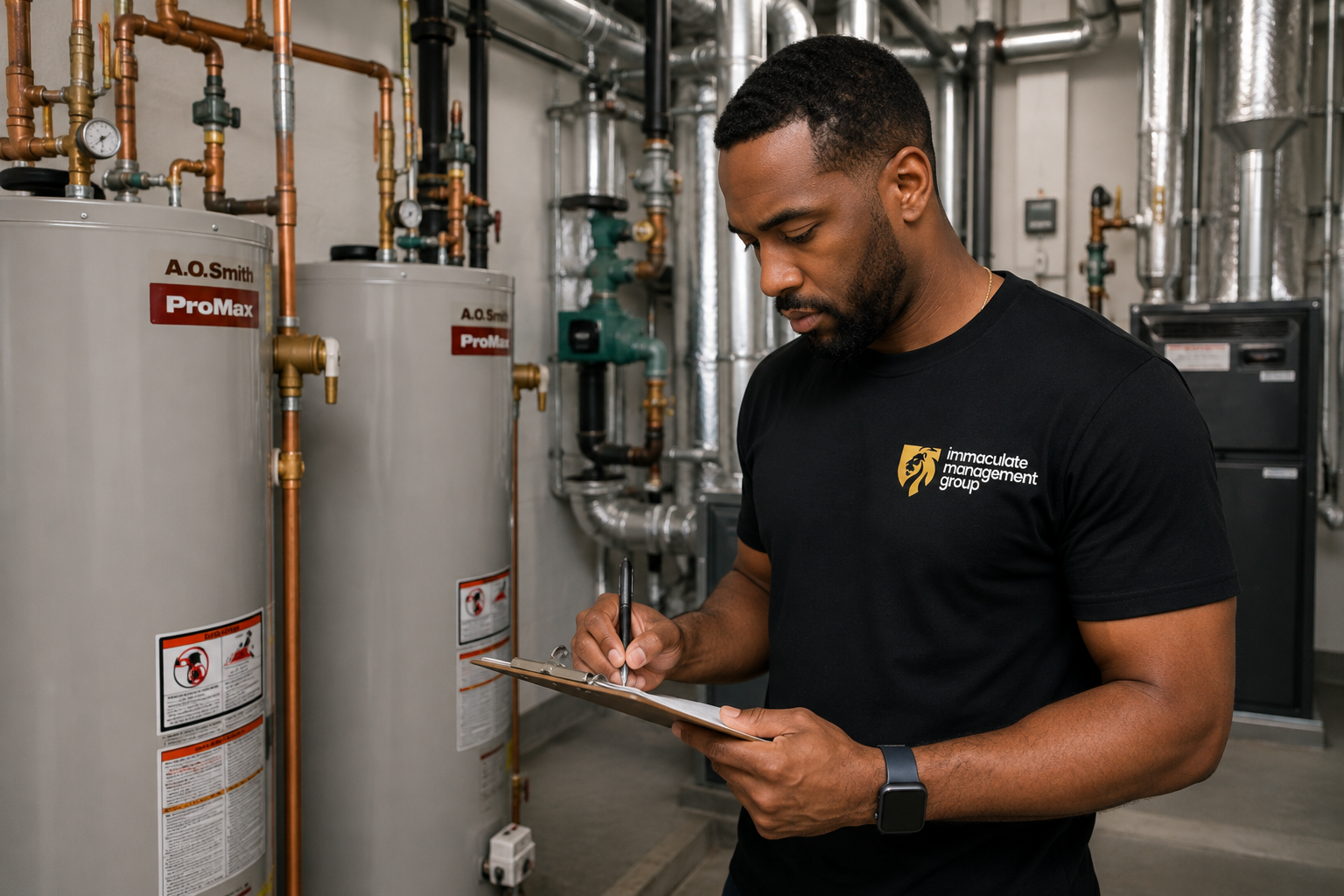
After roof-related water damage, plumbing failures are the second most common source of water damage claims in commercial properties. Insurance inspectors pay careful attention to visible plumbing infrastructure, the condition of water heaters and mechanical rooms, and the presence of any visible signs of previous or current water leaks.
Inspectors will note the age and condition of water heaters, the condition of visible supply and drain piping, the presence of any water staining or damage evidence on walls or ceilings near plumbing fixtures, and the condition of restrooms and any wet areas. They will look for evidence of deferred maintenance in mechanical rooms — rust, corrosion, sediment accumulation, improper repairs — that indicates a property management approach that allows systems to deteriorate.
What helps: regular plumbing maintenance, prompt attention to any evidence of leaks or drips, annual water heater inspection and maintenance, and keeping mechanical rooms clean, organized, and free of stored materials that would impede access or create fire risk.
5. Slip, Trip, and Fall Hazards
Commercial premises liability is one of the most significant insurance exposure categories for commercial property owners — and slip, trip, and fall incidents are the most common mechanism of premises liability claims. Insurance inspectors assess commercial properties specifically for conditions that create elevated slip, trip, and fall risk.
They will examine the condition of all walking surfaces — parking lots, sidewalks, entrance areas, corridors, stairways, and common areas — looking for cracks, uneven surfaces, damaged flooring, inadequate lighting, and other conditions that create fall risk. They will note whether floor surfaces are appropriate for their use and traffic level, whether transitions between surface types are properly managed, and whether any areas have conditions that have been allowed to deteriorate without remediation.
They will also look at lighting levels across the property. Inadequate lighting in parking areas, stairwells, corridors, and entrance areas is a consistent finding in commercial property inspections and a known contributor to slip, trip, and fall incidents.
What helps: regular walkthrough inspections that systematically identify and document surface condition issues, prompt repair of any cracked or uneven surfaces, regular parking lot and walkway maintenance, and ensuring lighting systems across the property are functional and adequate.
6. Security Systems and Access Control
The condition and adequacy of security systems — including access control, exterior lighting, and surveillance — is an increasingly important element of commercial property insurance inspections, particularly for properties in higher-crime areas or properties that house sensitive operations or valuable equipment.
Inspectors will note whether the property has functioning access control systems at primary entrances, whether exterior lighting is adequate and functioning across the property perimeter, and whether surveillance systems are present and operational. They will also look at the general security profile of the property — whether entry points are properly secured, whether there are obvious vulnerabilities that would make unauthorized access easy, and whether the property's security posture is consistent with its use and tenant profile.
What helps: ensuring all access control systems are functioning and properly maintained, conducting regular exterior lighting checks and promptly replacing failed fixtures, and maintaining surveillance systems in operational condition with documented maintenance records.
7. Environmental Hazards and Compliance
Environmental compliance is a specialized but increasingly important area of commercial property insurance inspection, particularly for older buildings and properties with known or suspected environmental exposures.
Inspectors will look for evidence of environmental hazards including asbestos-containing materials in poor condition, lead paint in deteriorating condition, underground storage tanks, chemical storage areas, and any conditions that suggest contamination or environmental liability. For older commercial buildings — particularly those built before 1980 — asbestos and lead paint are material concerns that insurers take seriously. The presence of these materials in good condition and properly managed is a manageable risk. The presence of deteriorating asbestos or lead paint is a significant finding.
What helps: having current environmental assessment documentation for older buildings, ensuring any known asbestos or lead paint containing materials are in good condition and properly managed, and maintaining compliance with any environmental regulations applicable to the property's operations.
8. Documentation and Management Systems
Perhaps the most underappreciated element of a commercial property insurance inspection is the assessment of the property owner's management systems and documentation practices.
Inspectors are trained to assess not just the physical condition of a property but the quality of the management approach behind it. A property owner who can produce organized, current documentation — inspection records, maintenance logs, vendor contracts, compliance certificates, repair histories — is demonstrating a management approach that reduces risk. A property owner who cannot produce documentation of basic maintenance activities is signaling a management approach that increases it.
Specifically, inspectors look for documentation of roof inspections, fire system inspections, elevator inspections where applicable, HVAC maintenance, pest control service, and any other inspections or maintenance activities required by local code or the policy itself. Missing documentation is treated as a finding even when the underlying work was performed — because undocumented maintenance cannot be verified and therefore cannot be credited in the risk assessment.
What helps: maintaining organized, accessible records of all inspection, maintenance, and compliance activities. A facility management partner who maintains service logs and inspection documentation as part of their standard operating procedure is providing documentation value that most property owners significantly underestimate until they need it.
What Happens When Inspectors Find Problems
Commercial property insurance inspections result in one of three outcomes for the property owner.
The first and best outcome is a clean inspection with no significant findings. The insurer confirms coverage at current terms, the premium reflects the property's well-maintained condition, and the relationship continues without disruption.
The second outcome is an inspection with findings that require attention. The insurer issues a list of items that need to be addressed — typically within 30 to 90 days — as a condition of continued coverage. This outcome is manageable if the property owner takes the findings seriously, addresses them promptly, and provides documentation of completion. It becomes problematic when findings are ignored or addressed slowly, which can trigger coverage suspension or non-renewal.
The third and worst outcome is an inspection that reveals significant, systemic maintenance deficiencies. In this scenario, the insurer may issue an immediate coverage restriction on certain categories of loss, significantly increase the premium to reflect the elevated risk profile, attach stringent conditions to continued coverage, or in the most serious cases, decline to renew the policy.
For a commercial property owner who discovers at renewal time that their insurer is declining to renew because of maintenance deficiencies — finding replacement coverage on short notice at a reasonable premium is difficult and sometimes impossible. The financial and operational consequences of a coverage gap on a commercial property are severe.

How Proactive Facility Management Prepares Your Building for Insurance Inspections
The connection between proactive facility management and commercial property insurance outcomes is direct and financially significant.
A commercial property that is systematically managed — with regular documented inspections, prompt attention to maintenance findings, current compliance records, and a single accountable partner watching the whole picture — is a property that is perpetually prepared for an insurance inspection. Not because the team is staging the building for an inspector's visit, but because the standard of management that produces good insurance inspection outcomes is the same standard that produces good building performance outcomes every day.
A proactive facility management partner contributes to insurance readiness in several specific ways. They conduct regular walkthroughs that identify conditions before they become inspection findings. They maintain service logs and inspection records that constitute the documentation insurers look for. They ensure compliance activities — fire system inspections, pest control, roof maintenance — are current and documented. And they address findings promptly rather than allowing them to accumulate.
For commercial property owners in Northeast Ohio, where seasonal weather conditions create consistent and predictable maintenance pressure on every building system, a proactive facility management approach is not just good building stewardship — it is sound insurance risk management.
The buildings that perform best in commercial property insurance inspections are the ones where someone has been systematically watching, documenting, and maintaining every element of the property — not just before the inspector arrives, but every day, in every season, as a standard operating practice.
That is what a genuine facility management partner provides. And in the context of commercial property insurance, the financial value of that partnership is measurable in lower premiums, broader coverage, fewer restrictive conditions, and the confidence that comes from knowing your building will pass the next inspection — whenever it arrives.
Immaculate Management Group is a full-service facility management contractor based in Northeast Ohio, providing commercial cleaning, landscaping, painting, pest control, project management, and transportation services to world-class commercial facilities. MBE/EDGE Certified. To speak with our team about your facility needs, contact us at info@theimggroup.comor call 440-833-4258.