
Why Cheap Facility Services Always Cost More in the Long Run

A property manager stands in a severely neglected commercial building lobby, holding a clipboard and looking up with concern—peeling walls, a broken ceiling light fixture, debris on the floor, and overgrown vegetation are visible through the entrance doors behind him. This is the reality of what cheap facility management produces over time.
There is a conversation that happens in almost every commercial facility management procurement process. The bids come in. The property manager or procurement team reviews them. And then, almost inevitably, the question gets asked: Can we find something cheaper?
It is a reasonable question. Facility management is a significant operating expense for any commercial property. Budget pressure is real. And on the surface, facility management services can look similar enough across providers that price becomes the easiest differentiator.
The problem is that cheap facility services are not actually cheap. They are expensive services with the cost deferred, distributed, and disguised in ways that make the true price invisible at the moment of decision. By the time the real cost becomes clear — in emergency repairs, tenant complaints, liability events, accelerated asset deterioration, and eventual provider replacement — the savings from the low-cost bid have long since been consumed and exceeded.
This post makes the case — in specific, financial terms—for why the cheapest facility management contract is almost always the most expensive facility management decision a commercial property owner can make.
How the Low-Cost Bid Actually Works
To understand why cheap facility services cost more in the long run, it helps to understand how a low-cost bid is constructed in the first place.
A facility management company that bids significantly below market rate is not doing so because they have discovered a more efficient way to deliver the same service. They are doing so because they have reduced the service — either explicitly, by narrowing the scope in ways that may not be immediately obvious from the contract language, or implicitly, by reducing the quality of labor, materials, frequency, or oversight that goes into delivering the service.
There are only a few levers a facility management company can pull to deliver services at below-market cost. They can pay their workforce less — which affects the quality and consistency of the people doing the work. They can reduce the frequency of service — which means less gets done and more accumulates between service visits. They can use lower-quality materials and supplies — which affects the results and the longevity of surfaces and systems being maintained. They can reduce supervision and quality control — which means problems go unnoticed and standards drift over time. Or they can simply not do everything the contract specifies — counting on the fact that most clients do not have the time or systems to verify compliance with every line item.
In practice, most low-cost facility management bids involve some combination of all of these. The result is not the same service at a lower price. It is a different service — one that looks the same on paper but delivers meaningfully less in practice.
The cost difference does not disappear. It gets transferred from the facility management invoice to the building — where it accumulates as accelerated deterioration, deferred problems, and the downstream expenses that follow when a building is not properly maintained.
The Seven Ways Cheap Facility Services Cost More
1. Accelerated Asset Deterioration
Every commercial building contains significant capital assets — flooring, wall finishes, fixtures, building systems, exterior surfaces — that have defined useful lives when properly maintained and significantly shorter lives when they are not.
Cheap facility services accelerate deterioration across every asset category they touch. Floors that are not properly cleaned and periodically restored wear faster. Exterior surfaces that are not regularly cleaned and inspected deteriorate faster. HVAC systems that are not properly maintained fail sooner. Fixtures that are cleaned with inappropriate products or techniques degrade faster.
The financial consequence is straightforward: assets that should last ten years last seven. Assets that should last fifteen years last ten. The replacement cost of those assets — carpet, hard flooring, exterior paint, fixtures, equipment — arrives years earlier than it should have, generating capital expenditures that were not in anyone's budget and that significantly exceed the cumulative savings from the low-cost facility contract.
Industry data on commercial building asset lifecycles consistently shows that properly maintained assets last 30 to 50 percent longer than poorly maintained ones across most categories. For a commercial building with significant invested capital in finishes and systems, the difference in replacement timing represents a financial impact that dwarfs any short-term savings from a reduced facility management budget.
2. Tenant Retention and Lease Renewal Impact
Tenants experience a building's facility management quality every single day. Not through reading inspection reports or reviewing service logs — but through walking into a lobby, using a restroom, navigating a corridor, and spending hours in a space that is either well-maintained or is not.
The research on commercial tenant retention consistently identifies building maintenance and management quality as one of the top three factors in lease renewal decisions. A tenant who experiences consistently poor facility quality — dirty common areas, slow response to maintenance requests, neglected grounds, flickering lights in corridors — is a tenant who is actively evaluating alternatives at renewal time, regardless of whether they have filed a formal complaint.
The financial cost of tenant turnover in a commercial building is significant and well-documented. Vacancy periods between tenants, tenant improvement allowances for incoming tenants, leasing commissions, and administrative costs associated with new leases typically total 15 to 30 percent of annual rent for the affected space. For a tenant paying $60,000 per year in rent, turnover costs of $9,000 to $18,000 represent a direct financial impact on the property owner that can be directly attributed — at least in part — to the facility management quality that influenced the renewal decision.
A commercial building that loses even one tenant renewal per year as a result of poor facility management quality — and replaces the savings from a cheap facility contract with the cost of one turnover event — has already consumed the savings and generated a net loss. In most cases, the math does not favor the low-cost bid.
3. Liability and Insurance Consequences
Cheap facility services create liability exposure that is invisible until it is very expensive.
A slip and fall on a floor that was not properly maintained. A pest infestation in a food-adjacent space that was not adequately treated. A mold issue in a restroom that was not properly cleaned and ventilated. An exterior lighting failure that was not reported and not addressed. Each of these incidents is more likely to occur in a building where facility services are delivered at minimum cost and minimum quality — and each carries liability consequences that can significantly exceed the value of the facility contract itself.
Commercial premises liability claims are among the most expensive categories of commercial litigation. A single significant slip-and-fall claim can cost $50,000 to $300,000 or more in legal fees, settlements, and associated expenses. A significant pest infestation in a regulated environment — healthcare, food service, childcare — can trigger regulatory action, temporary closure, and remediation costs that dwarf any facility budget line.
Beyond individual incident costs, a pattern of facility-related incidents affects insurance premiums on an ongoing basis. A commercial property with a history of premises liability claims pays higher insurance premiums — often for years after the incidents that triggered the increase. The cumulative insurance cost impact of poor facility management quality is a real and ongoing financial consequence that rarely gets attributed to the facility management decision that caused it.
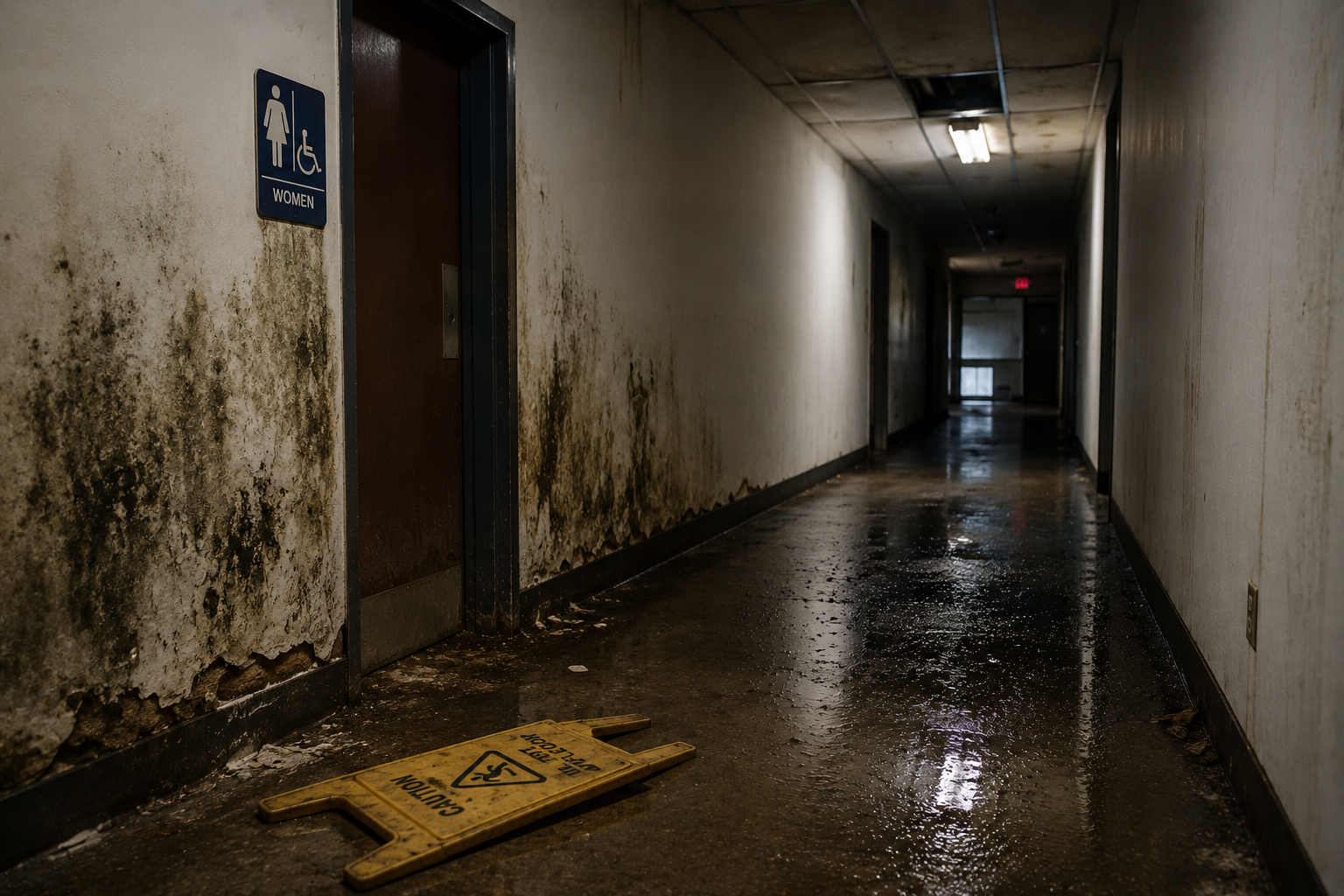
A severely neglected commercial building corridor outside a women's restroom — extensive black mold covering the walls from floor to ceiling, a wet flooded floor reflecting the dim overhead lighting, and a fallen caution wet floor sign lying face down on the ground. This image illustrates the liability exposure and health hazards that accumulate when facility maintenance is consistently underfunded or poorly delivered.
4. Emergency Repair Frequency and Cost
Buildings maintained by low-cost facility providers experience more frequent emergency repairs — and emergency repairs are significantly more expensive than planned maintenance.
The reason is straightforward. Preventive maintenance — the regular inspection, cleaning, adjustment, and minor repair that keeps building systems and surfaces functioning properly — is the mechanism by which small problems are caught before they become large ones. A facility management provider who is cutting costs cuts preventive maintenance first, because it is less visible than the cleaning and groundskeeping that tenants and property managers can directly observe.
The consequences of reduced preventive maintenance accumulate quietly. A slow drain that would have been caught and cleared during a regular restroom inspection becomes a blockage that requires emergency plumbing. A minor HVAC issue that would have been identified during a routine system check becomes a compressor failure during a July heat wave. A small exterior crack that would have been noted during a regular building walkthrough becomes a water infiltration problem after the first significant rainfall.
Each of these emergency repairs costs significantly more than the preventive maintenance that would have prevented it — typically three to five times more when emergency service premiums, after-hours call-out fees, and the cost of addressing secondary damage are factored in. Over the life of a facility management contract, the cumulative emergency repair premium generated by inadequate preventive maintenance is one of the largest hidden costs of a low-price facility management decision.
5. The Cost of Provider Replacement
One of the most consistently underestimated costs of choosing a cheap facility management provider is the cost of replacing them when the relationship fails — as it almost always does.
Provider replacement in commercial facility management is not a simple administrative transaction. It involves terminating a contract — which may carry financial consequences depending on the contract terms. It involves sourcing, evaluating, and onboarding a new provider — which requires significant management time and attention. It involves a transition period during which service quality is disrupted and the new provider is learning the building. And it involves the accumulated deferred maintenance and building condition issues that the outgoing provider created or failed to prevent — which the incoming provider will identify and the property owner will need to address.
The total cost of a provider replacement — including management time, transition disruption, contract termination costs, and the remediation of accumulated issues — can easily run to $10,000 to $30,000 or more for a medium-sized commercial building. For property owners who cycle through multiple low-cost providers over a five-year period, the cumulative replacement cost is a significant additional expense that was never part of the original cost comparison.
The facility management relationships that last — the ones that deliver consistent value over years rather than months — are almost never built on the lowest-cost bid. They are built on providers who were chosen for their capabilities, their track record, and their commitment to the building they serve. Those providers tend to cost more upfront. They tend to cost significantly less over time.
6. Management Time and Attention Cost
Managing a cheap facility management provider is expensive — not in dollars directly, but in the management time and attention it consumes.
A low-cost facility provider requires more oversight than a quality one. Issues need to be caught and reported because the provider is not proactively identifying them. Service completion needs to be verified because standards are inconsistent. Complaints from tenants or building users need to be tracked and escalated. Additional requests need to be negotiated and priced because the base scope was cut to achieve the low bid. And when problems occur — as they more frequently do — management time is consumed in addressing them, sourcing emergency alternatives, and managing the relationship.
The hourly cost of a property manager or facilities director's time is significant. When that time is consistently consumed by managing a low-cost facility provider rather than being directed toward higher-value activities, the true cost of the cheap contract includes a management overhead premium that rarely appears in any cost comparison but is very real in its impact.
A quality facility management partner reduces management burden rather than increasing it. They proactively report issues. They maintain consistent standards without requiring constant oversight. They handle additional requests efficiently. And when problems occur — as they occasionally do even with the best providers — they address them without requiring significant management intervention.
The management time savings of working with a quality facility partner — measured honestly in hours per week and valued at the cost of the management resource — is often sufficient on its own to justify the price premium over a low-cost alternative.
7. Reputation and Brand Impact
For commercial properties where the facility experience is part of the value proposition — Class A office buildings, premium retail spaces, healthcare facilities, hospitality-adjacent properties — the reputational cost of poor facility management quality is a real financial consequence that is difficult to quantify but impossible to ignore.
A prospective tenant touring a building that is visibly poorly maintained does not sign a lease. A client visiting a professional services firm in a building with dirty common areas and neglected grounds forms an impression of that firm that affects their confidence. A patient entering a healthcare facility that does not meet cleanliness expectations has a direct response that affects their perception of care quality.
These reputational consequences translate directly into financial outcomes — lost leases, reduced rental rates, slower absorption of available space, and the cumulative effect of a property that is known in its market for substandard maintenance.
The reverse is equally true. A commercial property that is consistently, visibly well-maintained commands premium rents, attracts quality tenants, and retains them at higher rates. The facility management investment that produces that outcome is not a cost center — it is a revenue driver.

The Immaculate Management Group team reviewing service data and inspection notes outside a well-maintained commercial office building — representing the professional, proactive approach to facility management that protects property value, retains tenants, and prevents the hidden costs that cheap facility services consistently produce.
What the True Cost Comparison Actually Looks Like
When all of the costs outlined in this post are included in the comparison — accelerated asset deterioration, tenant turnover impact, liability and insurance consequences, emergency repair premiums, provider replacement costs, management time overhead, and reputational impact — the cheap facility management contract almost never wins.
A facility management contract that is 20 percent below market rate saves, on a $100,000 annual contract, $20,000 per year. Against that saving, consider: one tenant non-renewal generating $12,000 in turnover costs. One emergency repair event that preventive maintenance would have caught, costing $4,000 instead of $800. One slip-and-fall incident generating $15,000 in legal costs. One provider replacement costing $15,000 in management time and transition expenses. Flooring replacement arriving two years early at a cost of $25,000.
That is $71,000 in costs — against $20,000 in savings. In a single year.
This is not a worst-case scenario. It is a realistic illustration of the cost categories that consistently appear when a commercial building is managed by a low-cost facility provider over time. The numbers will vary by building, by provider, and by circumstance. The direction of the comparison almost never does.
What Smart Property Managers in Northeast Ohio Do Instead
The commercial properties in Northeast Ohio that perform best over time — that retain tenants, minimize liability, protect asset value, and generate consistent returns — are not the ones with the lowest facility management costs. They are the ones with the right facility management relationships.
The right facility management relationship is not necessarily the most expensive one. It is the one where the provider's capabilities, track record, and commitment to the building justify the price they charge — and where the total cost of the relationship, including all the categories outlined in this post, is lower than the true total cost of a cheaper alternative.
Finding that relationship requires evaluating providers on the full picture of what they deliver — not just the number on the invoice. It requires asking the right questions during the procurement process, checking references from comparable properties, and understanding what is actually included in the scope of services being offered.
The cheapest bid in a facility management procurement process is almost always a signal worth investigating rather than a reason to celebrate. The question it should prompt is not "how do we capture this saving" but "what is this provider not doing that everyone else is?"
The answer to that question — honestly pursued — will almost always reveal the true cost of the cheap facility contract. And that cost is almost always higher than the alternative.
Immaculate Management Group is a full-service facility management contractor based in Northeast Ohio, providing commercial cleaning, landscaping, painting, pest control, project management, and transportation services to world-class commercial facilities. MBE/EDGE Certified. To speak with our team about your facility needs, contact us at info@theimggroup.com or call 440-833-4258.
4. Emergency Repair Frequency and Cost
Buildings maintained by low-cost facility providers experience more frequent emergency repairs — and emergency repairs are significantly more expensive than planned maintenance.
The reason is straightforward. Preventive maintenance — the regular inspection, cleaning, adjustment, and minor repair that keeps building systems and surfaces functioning properly — is the mechanism by which small problems are caught before they become large ones. A facility management provider who is cutting costs cuts preventive maintenance first, because it is less visible than the cleaning and groundskeeping that tenants and property managers can directly observe.
The consequences of reduced preventive maintenance accumulate quietly. A slow drain that would have been caught and cleared during a regular restroom inspection becomes a blockage that requires emergency plumbing. A minor HVAC issue that would have been identified during a routine system check becomes a compressor failure during a July heat wave. A small exterior crack that would have been noted during a regular building walkthrough becomes a water infiltration problem after the first significant rainfall.
Each of these emergency repairs costs significantly more than the preventive maintenance that would have prevented it — typically three to five times more when emergency service premiums, after-hours call-out fees, and the cost of addressing secondary damage are factored in. Over the life of a facility management contract, the cumulative emergency repair premium generated by inadequate preventive maintenance is one of the largest hidden costs of a low-price facility management decision.
5. The Cost of Provider Replacement
One of the most consistently underestimated costs of choosing a cheap facility management provider is the cost of replacing them when the relationship fails — as it almost always does.
Provider replacement in commercial facility management is not a simple administrative transaction. It involves terminating a contract — which may carry financial consequences depending on the contract terms. It involves sourcing, evaluating, and onboarding a new provider — which requires significant management time and attention. It involves a transition period during which service quality is disrupted and the new provider is learning the building. And it involves the accumulated deferred maintenance and building condition issues that the outgoing provider created or failed to prevent — which the incoming provider will identify and the property owner will need to address.
The total cost of a provider replacement — including management time, transition disruption, contract termination costs, and the remediation of accumulated issues — can easily run to $10,000 to $30,000 or more for a medium-sized commercial building. For property owners who cycle through multiple low-cost providers over a five-year period, the cumulative replacement cost is a significant additional expense that was never part of the original cost comparison.
The facility management relationships that last — the ones that deliver consistent value over years rather than months — are almost never built on the lowest-cost bid. They are built on providers who were chosen for their capabilities, their track record, and their commitment to the building they serve. Those providers tend to cost more upfront. They tend to cost significantly less over time.
6. Management Time and Attention Cost
Managing a cheap facility management provider is expensive — not in dollars directly, but in the management time and attention it consumes.
A low-cost facility provider requires more oversight than a quality one. Issues need to be caught and reported because the provider is not proactively identifying them. Service completion needs to be verified because standards are inconsistent. Complaints from tenants or building users need to be tracked and escalated. Additional requests need to be negotiated and priced because the base scope was cut to achieve the low bid. And when problems occur — as they more frequently do — management time is consumed in addressing them, sourcing emergency alternatives, and managing the relationship.
The hourly cost of a property manager or facilities director's time is significant. When that time is consistently consumed by managing a low-cost facility provider rather than being directed toward higher-value activities, the true cost of the cheap contract includes a management overhead premium that rarely appears in any cost comparison but is very real in its impact.
A quality facility management partner reduces management burden rather than increasing it. They proactively report issues. They maintain consistent standards without requiring constant oversight. They handle additional requests efficiently. And when problems occur — as they occasionally do even with the best providers — they address them without requiring significant management intervention.
The management time savings of working with a quality facility partner — measured honestly in hours per week and valued at the cost of the management resource — is often sufficient on its own to justify the price premium over a low-cost alternative.
7. Reputation and Brand Impact
For commercial properties where the facility experience is part of the value proposition — Class A office buildings, premium retail spaces, healthcare facilities, hospitality-adjacent properties — the reputational cost of poor facility management quality is a real financial consequence that is difficult to quantify but impossible to ignore.
A prospective tenant touring a building that is visibly poorly maintained does not sign a lease. A client visiting a professional services firm in a building with dirty common areas and neglected grounds forms an impression of that firm that affects their confidence. A patient entering a healthcare facility that does not meet cleanliness expectations has a direct response that affects their perception of care quality.
These reputational consequences translate directly into financial outcomes — lost leases, reduced rental rates, slower absorption of available space, and the cumulative effect of a property that is known in its market for substandard maintenance.
The reverse is equally true. A commercial property that is consistently, visibly well-maintained commands premium rents, attracts quality tenants, and retains them at higher rates. The facility management investment that produces that outcome is not a cost center — it is a revenue driver.