
The Hidden Expenses Inside Every Facility Budget That Nobody Talks About

A commercial property manager sits at a desk reviewing facility budget documents with a concerned expression, surrounded by spreadsheets, reports, a laptop, and a calculator — representing the complexity and hidden costs that consistently catch commercial building owners and managers off guard when managing facility budgets.
Every commercial property manager has experienced some version of the same conversation. The facility budget was set at the beginning of the year. It looked reasonable. It accounted for the regular cleaning contract, the landscaping schedule, the pest control program, and a line item for miscellaneous repairs. And then, somewhere between February and October, the budget was blown — not by one catastrophic event, but by a series of costs that nobody saw coming and that nobody had specifically planned for.
This is not a budgeting failure. It is a visibility failure. The costs that consistently break facility budgets are not random or unpredictable. They are structural — built into the nature of commercial facility operations in ways that most budget templates never capture. They show up every year, in every building, at every scale. The only thing that changes is whether the property manager was expecting them.
This post is about making those costs visible before they arrive. Not as a checklist of things to worry about, but as a framework for building a facility budget that actually reflects the full cost of operating a commercial building — so that the surprises stop being surprises.
Why Facility Budgets Consistently Underestimate Real Costs
Before examining the specific hidden expenses, it is worth understanding why they stay hidden in the first place.
Most facility budgets are built from one of three starting points. The first is last year's budget — adjusted slightly up or down based on general cost expectations. The second is the vendor contract — whatever the cleaning company, landscaping firm, or pest control provider charges becomes the budget line. The third is a templated industry benchmark — a percentage of building value or square footage used as a rough proxy for what facility management should cost.
All three approaches share the same fundamental weakness. They capture the costs that are already known and already contracted. They do not capture the costs that arise from the complexity of operating a real building in real conditions — the regulatory requirements that change, the systems that degrade faster than expected, the liability events that nobody anticipated, the coordination failures between vendors, and the dozens of small decisions that accumulate into significant expenditures over the course of a year.
The result is a budget that looks complete on paper but has structural gaps that will be filled — one way or another — before the year is over. Understanding where those gaps consistently appear is the first step toward closing them before they open.
The Hidden Expenses That Appear in Almost Every Facility Budget
1. Compliance and Regulatory Updates
Commercial buildings operate in a regulatory environment that changes constantly — and those changes consistently generate costs that were not in the original budget.
Fire safety inspections require documentation and sometimes remediation that was not anticipated. ADA compliance requirements generate modification costs when inspections reveal gaps. Health department standards for food service adjacent spaces change and require facility adjustments. Environmental regulations around cleaning chemicals, waste disposal, and pest control treatments evolve. Local building codes are updated and trigger compliance requirements for existing buildings during renovation or inspection cycles.
None of these costs are optional. And almost none of them appear in a standard facility budget because they are difficult to predict in advance. The specific regulation that will require a response, the specific inspection that will identify a gap, and the specific remediation cost that will result are all unknown at budget time.
The practical consequence is that compliance costs show up mid-year as unplanned expenditures — typically ranging from a few hundred dollars for minor documentation requirements to tens of thousands of dollars for significant remediation projects. Over the life of a multi-year facility management relationship, compliance costs are one of the most consistent sources of budget overrun in commercial buildings of every size and type.
What helps: building a dedicated compliance contingency line into the facility budget — typically 3 to 5 percent of total facility spend — specifically for regulatory requirements that cannot be fully predicted at budget time.
2. Vendor Coordination Failures and Gap Costs
Most commercial facilities use multiple vendors — a cleaning company, a landscaping provider, a pest control firm, a painting contractor, an HVAC maintenance company. Each vendor has their own schedule, their own scope, and their own definition of where their responsibility ends.
The gaps between those definitions are where costs accumulate invisibly.
A cleaning crew that mops a lobby floor does not consider it their responsibility to flag a slow drain that is beginning to back up. A landscaping crew that maintains the grounds does not consider it their responsibility to note that the exterior lighting over the parking area has two burned-out fixtures. A pest control technician who treats the building perimeter does not consider it their responsibility to document the gap in the building envelope near the loading dock that is allowing entry.
Each of these observations would have been made automatically — and reported — by a single integrated facility management partner watching the whole picture. With multiple independent vendors, they go unobserved until they become expensive.
The cost of vendor coordination failures is not a single line item. It is distributed across the year in the form of problems that were discovered late, repairs that cost more because they were not caught early, and liability events that occurred in the gaps between vendor scopes. Quantifying this cost precisely is difficult. Recognizing that it exists — and that it is a structural consequence of fragmented vendor management — is the first step toward addressing it.
What helps: either consolidating vendors under a single integrated facility management partner who is accountable for the whole picture, or assigning a dedicated internal coordination role whose specific responsibility is to manage the interfaces between vendors and ensure nothing falls through the gaps.
3. Emergency and Unplanned Repair Costs
Every facility budget has a line item for repairs. Almost none of them are large enough.
Emergency repairs — the flooding restroom, the failed HVAC compressor in July, the broken exterior door lock discovered on a Saturday morning, the pest infestation that appears between scheduled treatment cycles — do not arrive on a predictable schedule. They arrive when they arrive, and they carry a premium cost because of their urgency.
Emergency repair premiums are real and significant. A plumbing repair that costs $400 during regular business hours can cost $800 to $1,200 when called in as an emergency on a weekend. An HVAC service call that costs $300 as a scheduled maintenance visit can cost $600 to $900 when called as an emergency during a heat wave. A locksmith call during business hours costs a fraction of what the same service costs at midnight when a building cannot be secured.
Beyond the premium cost of the repair itself, emergency situations generate secondary costs that rarely appear in a budget. Tenant disruption during a repair. Temporary solutions that need to be maintained until a permanent fix is possible. Staff time consumed by crisis management. The administrative cost of sourcing emergency vendors quickly.
Industry data consistently suggests that unplanned maintenance and emergency repairs account for 15 to 30 percent of total facility maintenance spend in commercial buildings — significantly more than most facility budgets allocate. Buildings with strong preventive maintenance programs experience fewer emergencies and spend less on unplanned repairs. Buildings with deferred maintenance backlogs experience more.
What helps: allocating a realistic emergency repair reserve — typically 15 to 20 percent of total planned maintenance spend — and treating it as a genuine budget line rather than a fallback when the planned budget runs out.
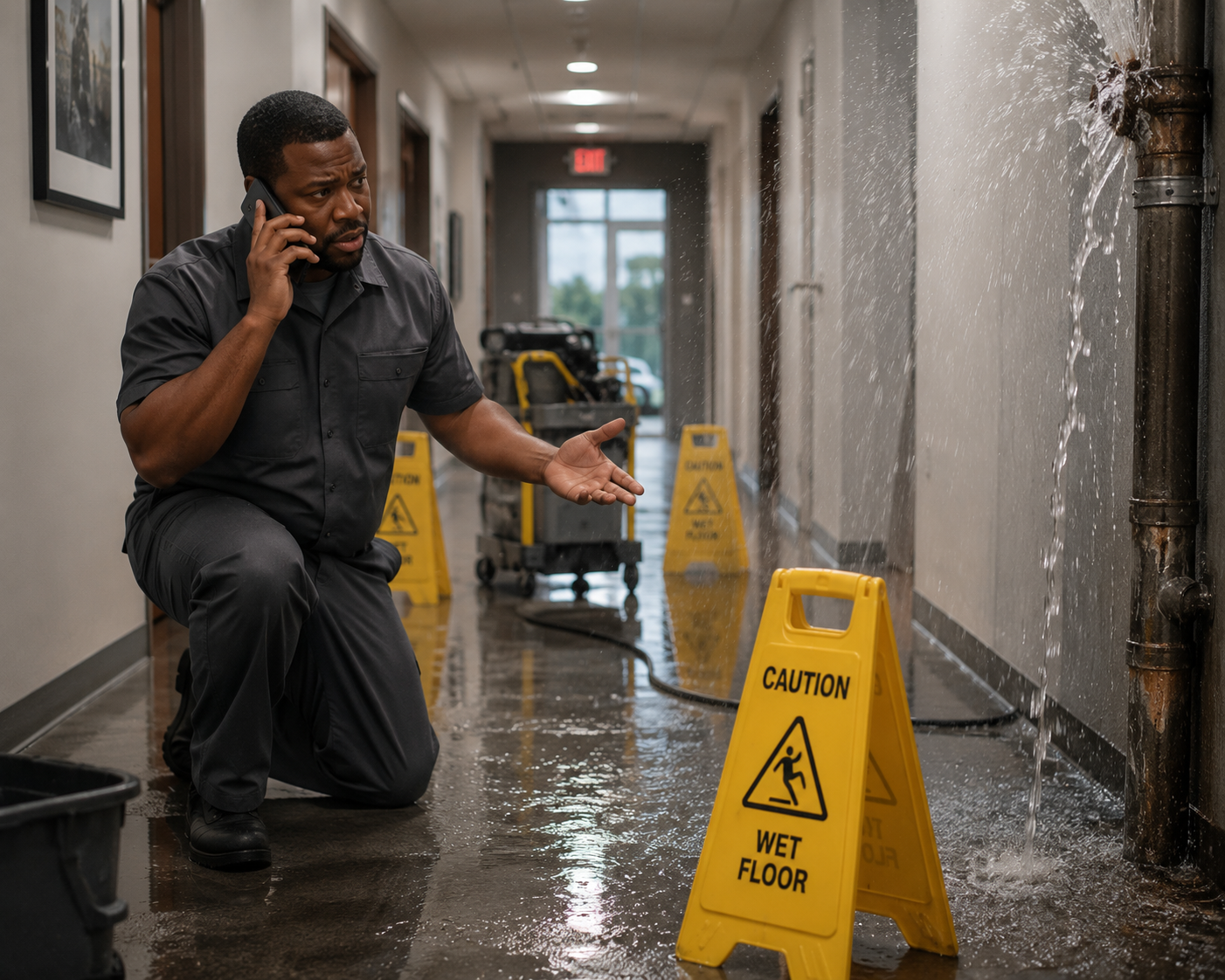
A maintenance worker crouches in a flooded commercial building corridor, on the phone calling for emergency assistance, as water bursts from a broken pipe on the wall. Wet floor caution signs are placed around the area — a vivid illustration of the unplanned emergency repair costs that consistently exceed facility budget allocations in commercial properties.
4. Seasonal Transition Costs
Northeast Ohio's climate creates predictable but consistently underbudgeted transition costs at every seasonal change.
Spring brings the aftermath of winter — parking lot damage from freeze-thaw cycles, landscaping restoration after snow and ice, exterior surface cleaning after months of salt and grime accumulation, drainage system clearing after debris accumulation over winter. These are not optional — they are the minimum required to return the property to acceptable operating condition after a Northeast Ohio winter.
Summer brings pest pressure escalation, increased grounds maintenance frequency, HVAC system strain from heat and humidity, and the window for exterior painting and surface work that cannot be done in cold or wet conditions. Each of these creates costs that are either higher in summer than other seasons or unique to the summer months.
Fall brings pre-winter preparation — gutters and drainage systems cleared before freeze cycles begin, landscaping winterized, exterior equipment protected, building systems inspected and serviced before the heating season begins. Skipping or reducing fall preparation consistently generates higher spring remediation costs.
Winter brings snow and ice management — one of the most significant and most variable facility cost categories for Northeast Ohio commercial properties. Snow removal costs are directly dependent on weather conditions that cannot be accurately predicted at budget time. A mild winter generates minimal costs. A severe winter with multiple significant snowfall events generates costs that can be two to three times the budgeted amount.
The pattern across all four seasonal transitions is the same: the costs are predictable in category if not in precise amount, they occur every year, and they are consistently underrepresented in facility budgets that were built without specific seasonal modeling.
What helps: building a seasonal transition budget specifically for each of the four transition periods — not lumped into a general maintenance line but allocated specifically to the work each transition requires. For snow removal specifically, building in a weather contingency reserve that reflects the variability of Northeast Ohio winters.
5. Tenant-Driven Maintenance Requests
In multi-tenant commercial buildings, tenant-driven maintenance requests are one of the most consistent sources of unbudgeted facility spend — and one of the least visible until it is too late to plan for.
Tenants generate maintenance requests for a wide range of reasons. Some are legitimate building maintenance issues — a light fixture that has failed, a door that is not closing properly, a restroom fixture that needs attention. These are generally the facility manager's responsibility and should appear in the budget.
But a significant portion of tenant-driven requests fall into gray areas that are not clearly covered by either the tenant's lease responsibilities or the facility manager's standard maintenance scope. Touch-up painting after a tenant moves furniture. Carpet cleaning in a space that has seen heavy use. Additional cleaning services before a tenant's important client visit. Minor modifications to accommodate a tenant's operational changes. Each of these individually is a small cost. Across multiple tenants over the course of a year, they accumulate into a significant unbudgeted expenditure.
The challenge is compounded by the relationship dynamic. Facility managers who want to maintain good tenant relationships — and who understand that tenant satisfaction directly affects lease renewal rates — often absorb these requests rather than push back on them, creating costs that never make it into the formal budget.
What helps: creating a clear tenant request policy that defines what is included in standard facility maintenance, what falls under tenant responsibility, and what can be accommodated as an additional service at a defined rate. Transparency at the lease signing stage about these boundaries prevents the ambiguity that generates unplanned costs throughout the tenancy.
6. Insurance and Liability Related Costs
Facility-related insurance and liability costs are among the most consistently underbudgeted categories in commercial property management — partly because they are irregular in timing and partly because they are often absorbed by the organization's general liability budget rather than attributed to facility management specifically.
Premises liability claims — slip and falls, injuries from facility defects, property damage from maintenance failures — generate legal costs, settlement costs, and insurance premium increases that can significantly exceed any single year's facility maintenance savings. A single significant premises liability claim can cost $50,000 to $500,000 or more in legal fees, settlements, and associated expenses.
Workers' compensation claims involving facility maintenance staff — whether employed directly or through a vendor — can generate costs that are not fully covered by vendor insurance and that ultimately impact the property owner's insurance profile.
Insurance premium increases following facility-related claims are a delayed cost that most budget processes do not adequately capture. A claim in year one generates a premium increase in year two that was not in the budget when it was set.
Property insurance requirements also generate facility costs. Many commercial property insurers require documented evidence of regular maintenance, inspection, and risk management practices as a condition of coverage or coverage renewal. Meeting these requirements generates administrative and operational costs that are often not specifically budgeted.
What helps: working with an insurance professional to understand the specific facility-related requirements of the property's coverage, building the cost of meeting those requirements into the facility budget explicitly, and maintaining documentation of all maintenance and inspection activities in a format that supports insurance compliance.
7. Technology and Systems Upgrade Costs
Commercial building technology — access control systems, security cameras, fire alarm panels, HVAC controls, lighting management systems — ages and requires upgrade on cycles that most facility budgets do not specifically plan for.
The problem is not that these upgrades are unpredictable. Every technology system has a known lifespan, and the general timing of when it will need to be replaced or significantly upgraded can be estimated with reasonable accuracy. The problem is that facility budgets rarely include a technology replacement reserve that accumulates over time toward these known future costs.
The result is that when a technology upgrade is needed — when the access control system reaches end of life, when the fire alarm panel requires a code-mandated upgrade, when the security camera system fails and needs replacement — the cost appears as an emergency capital expenditure rather than a planned investment. The full cost hits a single budget year rather than being distributed across the useful life of the system.
For a commercial building with multiple technology systems at different points in their lifecycle, the aggregate replacement cost over any given five-year period can be significant — often running into tens of thousands of dollars for a medium-sized commercial building.
What helps: creating a technology replacement schedule that documents every major building technology system, its approximate remaining useful life, and its estimated replacement cost. Using that schedule to build a technology reserve into the annual facility budget — distributing the future cost across the years between now and when the replacement will be needed.

The Immaculate Management Group facility team gathered around a conference table for a strategic facility budget review session — analyzing budget charts, building plans, and financial reports spread across the table, with tablets and a Facility Budget Overview displayed on the screen behind them. This is what proactive facility budget planning looks like in practice — a dedicated team identifying hidden costs before they become surprises.
Building a Facility Budget That Captures the Full Picture
The hidden expenses outlined in this post are not actually hidden in the sense of being unknowable. They are hidden in the sense of being structurally excluded from the budget frameworks most commercial property managers use. Once they are made visible — once they are named, categorized, and allocated — they can be planned for rather than absorbed.
A facility budget that captures the full picture of commercial building operating costs includes the following elements that most budgets currently omit:
A compliance contingency of 3 to 5 percent of total facility spend, reserved specifically for regulatory requirements that cannot be fully predicted at budget time.
A vendor coordination allocation — either the cost of an integrated facility partner or a dedicated internal coordination role — that ensures nothing falls through the gaps between vendor scopes.
An emergency repair reserve of 15 to 20 percent of total planned maintenance spend, treated as a genuine budget line rather than an overflow category.
Seasonal transition budgets for each of the four seasonal changes, built from a realistic assessment of what each transition requires for the specific property and the specific climate.
A tenant request policy and associated budget that reflects the realistic volume and nature of tenant-driven maintenance needs for the specific building and tenant mix.
Insurance and compliance costs that are identified in consultation with the property's insurance professional and built into the facility budget explicitly.
A technology replacement reserve built from a documented replacement schedule for all major building technology systems.
What This Means for Northeast Ohio Commercial Properties
For commercial property owners and managers in Northeast Ohio, the hidden expense categories outlined in this post are not abstract risks — they are the specific, recurring costs that Northeast Ohio's climate, regulatory environment, and commercial real estate market consistently generate.
The seasonal transition costs are real and significant in a region with genuine winters, genuine springs, and genuine summers. The compliance costs reflect an active local regulatory environment. The emergency repair premiums reflect the reality of operating buildings in a market where vendor availability during peak demand periods affects response time and cost.
The commercial properties in Northeast Ohio that manage these costs most effectively are not the ones with the largest budgets. They are the ones with the most complete and accurate picture of what operating their building actually costs — and the facility management partners who help them see that picture clearly, plan for it accurately, and manage it proactively throughout the year.
A facility budget is only as useful as it is accurate. And accuracy requires seeing the full cost of facility operations — not just the costs that were easy to anticipate, but the ones that have been hiding in plain sight.
Immaculate Management Group is a full-service facility management contractor based in Northeast Ohio, providing commercial cleaning, landscaping, painting, pest control, project management, and transportation services to world-class commercial facilities. MBE/EDGE Certified. To speak with our team about your facility needs, contact us at info@theimggroup.comor call 440-833-4258.