
What Deferred Facility Maintenance Actually Costs Over 24 Months
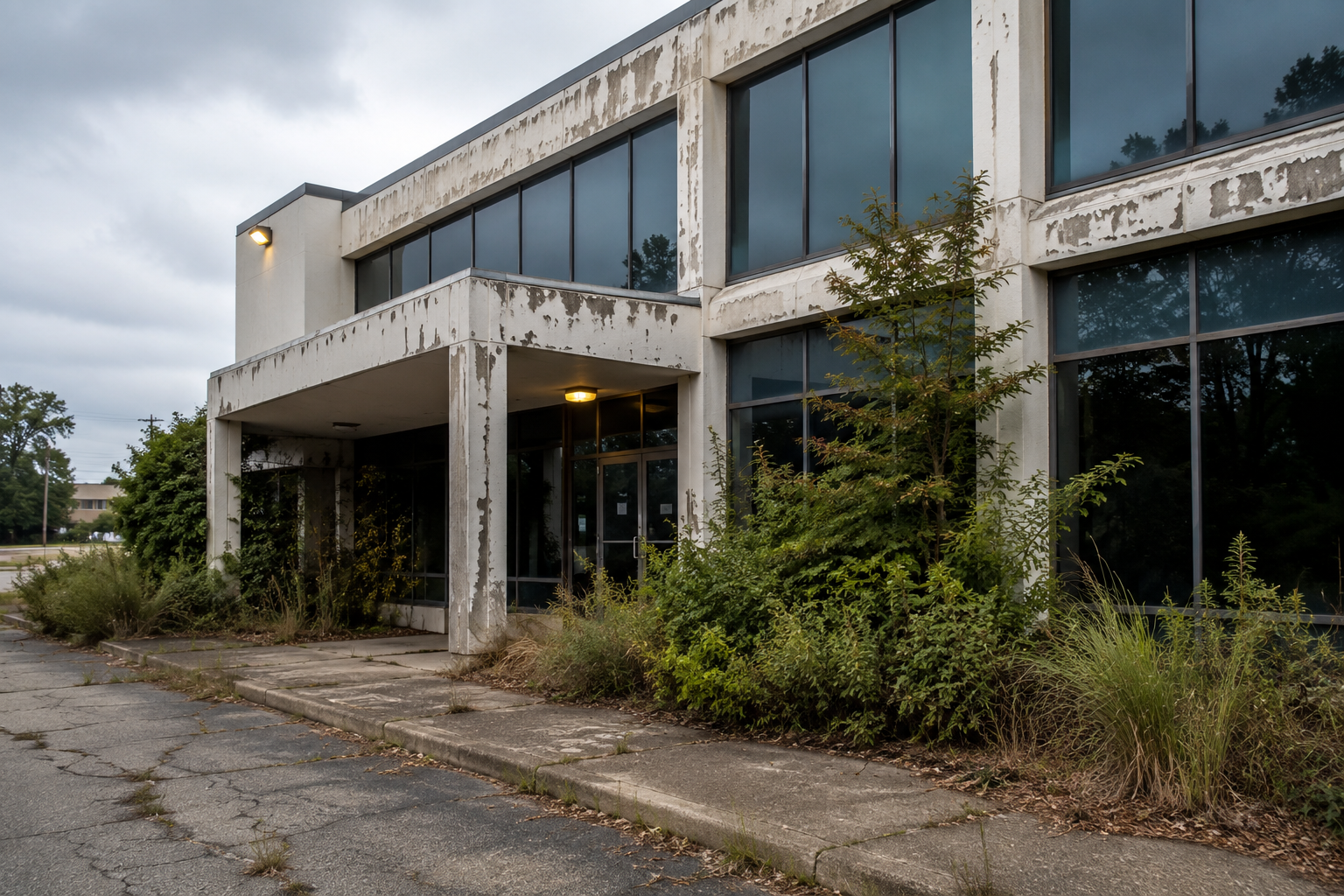
A commercial office building showing the visible consequences of years of deferred maintenance — extensive paint peeling across the entire facade, overgrown and unmanaged landscaping overtaking the entrance and walkways, cracked and deteriorated parking lot surfaces, and neglected exterior lighting. This is what happens when routine facility maintenance is consistently postponed.
There is a decision that happens in commercial facility management so quietly and so regularly that most property managers do not even recognize it as a decision. It happens when a maintenance request comes in and gets flagged as non-urgent. It happens when a budget review leads to postponing a scheduled inspection. It happens when a small repair gets added to a list that never quite gets addressed. It happens when the phrase "we'll get to it next quarter" becomes the default response to anything that is not an emergency.
That decision is deferred maintenance. And it is costing commercial property owners and managers far more than they realize.
The challenge with deferred maintenance is that its true cost is almost never visible at the moment the deferral happens. When you decide to postpone a roof inspection, the cost of that decision does not appear on any invoice that month. When you delay repainting the building exterior, nothing breaks immediately. When you put off addressing a slow drain in the second-floor restroom, operations continue normally. The consequences of these decisions are delayed, distributed, and often attributed to causes other than the original deferral when they eventually arrive.
This is what makes deferred maintenance so dangerous. It does not look like a problem when it is happening. It looks like a problem when it becomes expensive — and by then, the original decision to defer has long been forgotten.
This post examines what deferred facility maintenance actually costs over a 24-month period across the most common categories of commercial building maintenance. Not in abstract terms — in real, specific, calculable consequences that show up in repair bills, tenant complaints, liability exposure, and property value.
What Deferred Maintenance Actually Means
Before examining the costs, it is worth being precise about what deferred maintenance actually is — because it is often confused with prioritization, which is something different.
Prioritization is the legitimate process of deciding which maintenance tasks are most urgent given available resources. Some maintenance genuinely can wait. Some cannot. A well-managed facility has a clear understanding of which is which, and makes those decisions based on risk assessment, manufacturer recommendations, and the specific condition of the building.
Deferred maintenance is something different. It is the systematic postponement of maintenance that is known to be needed, for reasons that are primarily budgetary or organizational rather than genuinely strategic. It is the accumulation of known issues that have been intentionally set aside — not because they are low priority, but because addressing them requires resources or attention that are not currently available or allocated.
The distinction matters because deferred maintenance always creates a liability that grows over time. Unlike true low-priority maintenance — which can be safely delayed without significant consequence — deferred maintenance is, by definition, maintenance that needs to happen. Every day it does not happen, the underlying condition worsens, the eventual repair becomes more complex, and the risk of a more serious failure increases.
Most commercial properties carry some level of deferred maintenance at any given time. The question is not whether any exists — it is how much, what categories it falls into, and whether the organization understands what that backlog is actually costing them.
The 24-Month Cost Model: How Small Deferrals Compound
To understand what deferred maintenance costs over 24 months, it helps to think in terms of compounding — the same principle that makes financial interest grow over time. A maintenance issue that costs $500 to address today does not stay at $500 if left unaddressed. It grows, sometimes slowly, sometimes suddenly, but almost always in one direction.
Here is how that compounding plays out across the most common categories of commercial facility maintenance.
Exterior Building Maintenance
Exterior maintenance — paint, sealant, caulking, window frames, exterior lighting, signage — is among the most commonly deferred category of commercial building maintenance. It is visible to everyone, which means its deterioration affects first impressions, tenant satisfaction, and property value. But because deterioration happens gradually, the urgency of addressing it is easy to underestimate.
Consider a commercial building where exterior repainting is deferred for 24 months beyond the recommended maintenance cycle. In month one, the consequence is cosmetic — slightly faded paint that most people would not notice. By month six, the fading is visible and a professional observer would note it. By month twelve, paint is beginning to peel in areas with high UV exposure or moisture contact. By month eighteen, peeling paint is exposing the substrate to water infiltration. By month twenty-four, water infiltration has compromised sections of the exterior wall assembly, requiring not just repainting but remediation of moisture damage to the underlying structure.
The repainting that would have cost $8,000 to $15,000 at the scheduled maintenance interval now costs $25,000 to $45,000 once moisture damage remediation is included — and that figure does not include the cost of any interior damage caused by water infiltration that was not caught until it became visible.
Similar compounding applies to caulking and sealant around windows and penetrations, exterior lighting fixtures that are not maintained, and walkway surfaces that develop cracks. In each case, the early-stage cost of maintenance is a fraction of the late-stage cost of repair.
Janitorial and Deep Cleaning
Janitorial maintenance is the category most property managers think of as straightforward — either the cleaning gets done or it does not. But within janitorial operations there is a significant distinction between routine cleaning and periodic deep cleaning, and it is the latter that most commonly gets deferred.
Routine cleaning — daily or weekly surface maintenance — typically continues even when facility budgets are under pressure. But periodic deep cleaning cycles — carpet extraction, hard floor stripping and refinishing, high-level dusting, HVAC vent cleaning, grout restoration — are the first to be reduced or eliminated when costs need to be cut.
Over 24 months, deferred deep cleaning has several compounding cost consequences.
Flooring deteriorates faster without periodic restoration. Carpet that is vacuumed daily but never extracted accumulates embedded soil that accelerates fiber breakdown. Hard floors that are mopped regularly but never stripped and refinished develop permanent surface damage that eventually requires replacement rather than restoration. The cost difference between periodic restoration and eventual replacement is significant — carpet replacement in a medium-sized commercial building can cost $15,000 to $50,000 or more, compared to periodic cleaning cycles that might cost $1,500 to $3,000 per year.
HVAC systems that are not regularly cleaned accumulate dust and particulate matter that reduces efficiency and eventually causes mechanical problems. An HVAC system operating with restricted airflow due to dirty filters and ducts consumes significantly more energy than a clean system — studies consistently show that HVAC systems account for 40 to 60 percent of commercial building energy consumption, and that poorly maintained systems operate at 10 to 25 percent reduced efficiency. Over 24 months, that efficiency loss translates directly to higher utility costs that dwarf the cost of the cleaning that would have prevented them.
Indoor air quality deteriorates when deep cleaning is deferred, with measurable consequences for tenant and employee health. Poor indoor air quality is associated with increased sick days, reduced productivity, and in severe cases, tenant complaints and lease terminations. While these costs are harder to calculate than a repair bill, they are real and they accumulate over time.
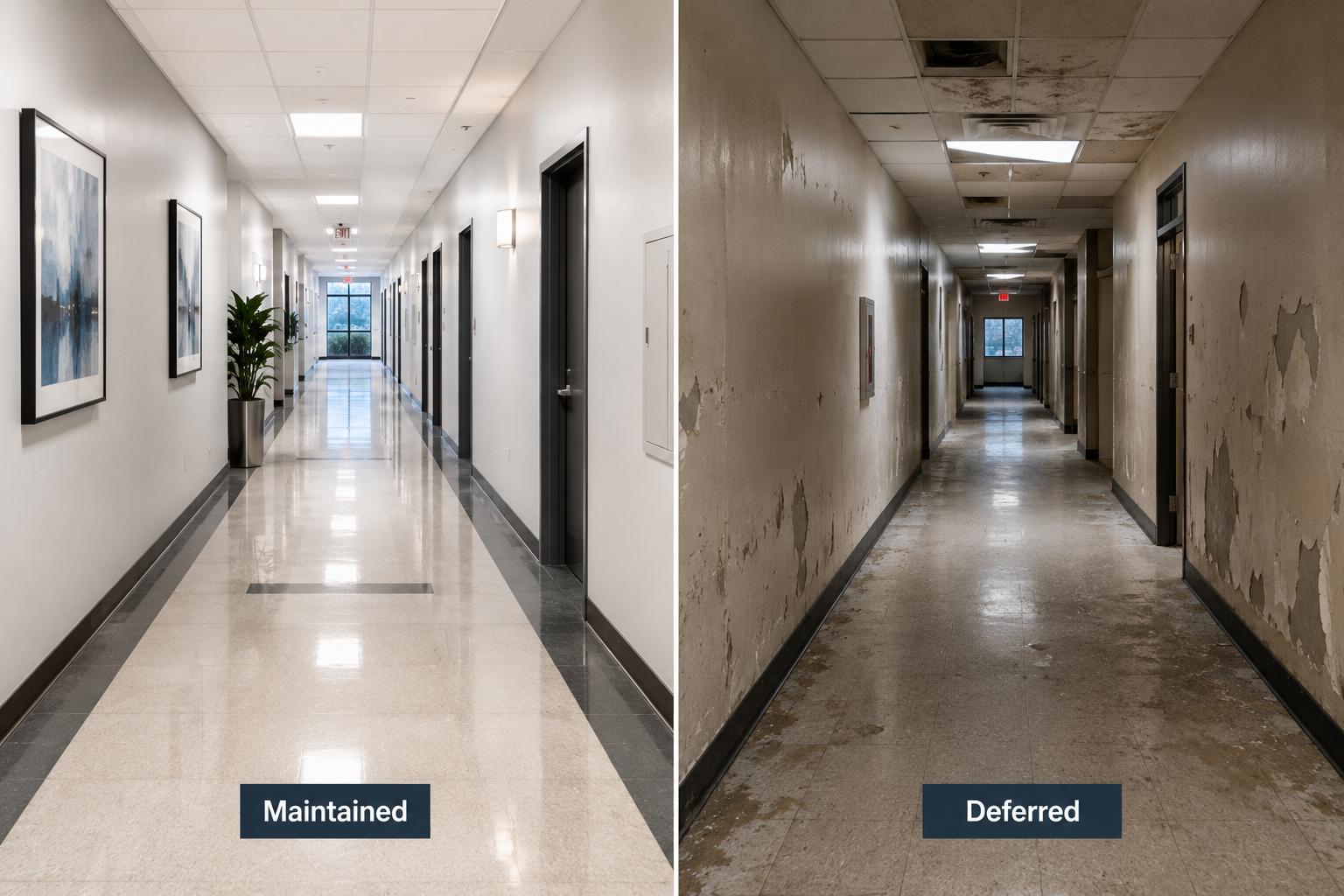
A side-by-side comparison of two commercial building corridors illustrating the real-world impact of facility maintenance decisions. The left side shows a well-maintained corridor — polished floors, clean white walls, bright lighting, artwork, and a healthy indoor plant. The right side shows the same corridor type after years of deferred maintenance — peeling walls, stained and deteriorated flooring, water-damaged ceiling tiles, and dim lighting. The visual difference represents not months but years of compounding neglect.
Landscaping and Grounds Maintenance
Grounds maintenance is frequently reduced during budget pressures because its consequences feel less urgent than interior or structural maintenance. Overgrown landscaping does not immediately threaten building operations. But the 24-month cost of deferred grounds maintenance extends well beyond aesthetics.
First impressions are a documented factor in commercial leasing decisions. Research on commercial real estate consistently shows that the exterior appearance of a property — including landscaping — significantly influences prospective tenant decisions. A property with neglected grounds loses competitive positioning in the leasing market, which affects occupancy rates and rental income over time. For a commercial building generating $500,000 in annual rental income, even a modest 5 percent reduction in occupancy attributable partly to poor exterior presentation represents $25,000 in lost revenue per year.
Drainage systems embedded in landscaping that are not regularly maintained become blocked with debris, leading to standing water, erosion, and eventually damage to paving, foundations, and building structures. Irrigation systems that are not properly maintained waste water and fail to keep landscaping healthy, accelerating the deterioration that eventually requires expensive replanting.
Pest pressure increases significantly when grounds are neglected. Overgrown vegetation provides harborage for insects and rodents, increasing the likelihood of pest infiltration into the building itself. A commercial pest infestation — particularly in a food service, healthcare, or professional services environment — can trigger regulatory consequences, tenant complaints, and significant remediation costs that far exceed the cost of the grounds maintenance that would have prevented the conditions enabling it.
Pest Control
Pest control is one of the most dramatically compounding categories of deferred maintenance in commercial facilities. The cost differential between prevention and remediation is among the highest of any maintenance category.
Preventive pest management for a medium-sized commercial building — regular inspections, perimeter treatments, exclusion maintenance, monitoring — typically costs between $2,000 and $6,000 per year depending on building size and local pest pressure.
A significant pest infestation requiring professional remediation — rodents in a server room, cockroaches in a food preparation area, bed bugs in a hospitality or healthcare setting — can cost $5,000 to $50,000 or more to address, depending on severity and the type of pest involved. That figure does not include the indirect costs: tenant disruption, potential regulatory action, reputational damage, or in extreme cases, temporary closure.
Over 24 months without preventive pest management, the probability of a significant infestation event increases substantially — particularly in commercial buildings in Northeast Ohio where seasonal pest pressure is significant. The fall rodent migration, summer insect activity, and moisture-related pest pressure from spring and late autumn create consistent seasonal risk that preventive programs are specifically designed to manage.
The economics of pest control are among the clearest in the entire maintenance category. The return on investment of preventive pest management, measured against the cost of a single significant infestation event, is rarely less than 10 to 1 and often considerably higher.
Painting and Interior Finishes
Interior painting and finish maintenance is consistently among the first casualties of a deferred maintenance program — and consistently among the most consequential in terms of tenant experience and retention.
The condition of interior finishes directly affects how tenants experience their space every single day. Scuffed walls, stained ceilings, chipped door frames, and worn flooring communicate to tenants — consciously or unconsciously — that the building is not well cared for. Over time, this perception accumulates into dissatisfaction that manifests at lease renewal time.
Research on commercial tenant retention consistently identifies building maintenance and management quality as a top-three factor in lease renewal decisions. A tenant who has spent 24 months watching the building's interior finishes deteriorate without intervention is a tenant who is actively evaluating alternatives at renewal time — regardless of whether they have articulated specific complaints during the lease term.
The cost of tenant turnover in a commercial building is significant. Vacancy periods between tenants, tenant improvement allowances for new tenants, leasing commissions, and administrative costs associated with new leases can easily total 15 to 30 percent of annual rent for a given space. For a tenant paying $50,000 per year in rent, turnover costs of $7,500 to $15,000 represent a significant financial impact that dwarfs the cost of the interior maintenance that might have influenced the renewal decision.
The Hidden Costs That Never Appear on a Maintenance Invoice
Beyond the direct repair and replacement costs, deferred maintenance generates several categories of cost that are real but rarely attributed to their actual cause.
Liability exposure increases with every deferred maintenance item. A cracked walkway that has been on the maintenance list for six months is a liability risk that grows with every day it remains unaddressed. If a slip-and-fall incident occurs on that walkway, the documented history of the known defect — and the failure to address it — significantly affects the legal and insurance consequences. Commercial premises liability claims are among the most expensive categories of commercial litigation, and deferred maintenance is one of the most common contributing factors.
Energy costs increase as building systems deteriorate. HVAC systems, lighting, building envelope, and plumbing all operate less efficiently when maintenance is deferred. The cumulative energy cost of operating a poorly maintained commercial building versus a well-maintained one can be substantial — industry estimates consistently place the energy efficiency premium of well-maintained commercial buildings at 10 to 30 percent compared to comparable buildings with deferred maintenance programs.
Staff productivity and tenant satisfaction decline in poorly maintained environments. While these costs are difficult to quantify precisely, the research connecting physical environment quality to occupant wellbeing and productivity is extensive and consistent. A building that is visibly deteriorating creates a less productive, less satisfying environment for everyone who uses it — and that has real economic consequences for the businesses that occupy it.
Property value declines as deferred maintenance accumulates. Commercial property valuations are directly affected by the condition of the building and the quality of its maintenance history. A building with a documented history of deferred maintenance and the physical evidence that comes with it — deteriorated exterior, aging systems, worn finishes — will be valued lower than a comparable building with a strong maintenance record. For property owners, this represents a real reduction in asset value that compounds over time.

The Immaculate Management Group facility management team conducting a property review outside a commercial building. Four team members in branded black IMG uniforms are actively engaged — reviewing inspection data on a tablet, referencing a clipboard, and holding building plans — demonstrating the kind of thorough, collaborative, and proactive approach to facility management that prevents the deferred maintenance costs outlined in this post.
What 24 Months of Proactive Maintenance Looks Like Instead
The 24-month cost model works in both directions. Just as deferred maintenance compounds into increasingly expensive consequences, proactive maintenance compounds into increasingly valuable outcomes.
A commercial building on a proactive maintenance program over 24 months experiences lower repair costs because issues are identified and addressed before they become structural problems. It experiences lower energy costs because building systems are maintained at peak efficiency. It experiences higher tenant retention because the physical environment consistently meets or exceeds expectations. It experiences lower liability exposure because known defects are systematically addressed rather than accumulated. And it retains higher property value because its maintenance history documents consistent care rather than systematic neglect.
The financial case for proactive facility maintenance over a 24-month period is not complicated. The costs of maintenance are predictable, budgetable, and relatively modest when distributed across a regular schedule. The costs of deferred maintenance are unpredictable, concentrated, and significantly higher than the maintenance they replace — often by a factor of three to ten times, depending on the category and the duration of the deferral.
The organizations that understand this — that treat facility maintenance as a financial strategy rather than a cost to be minimized — consistently outperform those that do not on every relevant metric: lower operating costs, higher tenant retention, better property values, and reduced liability exposure.
What Property Managers and Owners in Northeast Ohio Should Do Right Now
If you manage or own commercial property in Northeast Ohio, the practical application of everything in this post begins with one exercise: a current deferred maintenance audit.
Walk your property — or have a trusted facility management partner walk it — and document every known maintenance item that has been deferred, regardless of how minor it appears. Assign each item a category, an estimated current repair cost, and an estimated cost if deferred for another 12 months. What you will find, in almost every case, is that the 12-month deferred cost is significantly higher than the current cost — and that the aggregate financial exposure of your deferred maintenance backlog is larger than you expected.
That exercise is the beginning of a proactive maintenance strategy. It converts deferred maintenance from a vague organizational habit into a specific, quantifiable liability — one that can be systematically addressed with a structured maintenance program and the right facility management partner.
The goal is not to address everything immediately. It is to understand what exists, prioritize by risk and cost trajectory, and begin reducing the backlog systematically while preventing new deferrals from accumulating.
For commercial properties in Northeast Ohio — where seasonal conditions create consistent and predictable maintenance pressure — a proactive approach is not a luxury. It is a financial necessity. The buildings that are best positioned heading into each new season are the ones whose owners and managers made proactive decisions in the season before.
The 24-month cost of deferred maintenance is significant. The 24-month return on proactive maintenance is more significant still. The choice between them is made one maintenance decision at a time.
Immaculate Management Group is a full-service facility management contractor based in Northeast Ohio, providing commercial cleaning, landscaping, painting, pest control, project management, and transportation services to world-class commercial facilities. MBE/EDGE Certified. To speak with our team about your facility needs:
Contact us at info@theimggroup.com or call 440-833-4258.