
Commercial Renovation Project Manager in Cleveland: How Strategic Oversight Protects Cost, Compliance, and Operations
Introduction
A regional healthcare operator in Cleveland recently faced a familiar dilemma. Their outpatient facility needed a full interior renovation, new mechanical systems, updated patient areas, and strict compliance with healthcare regulations, but shutting down operations wasn’t an option. Delays would cost revenue. Mistakes would cost trust.
They didn’t just need a contractor.
They needed a commercial renovation project manager who could orchestrate people, processes, permits, budgets, and timelines without disrupting daily operations.
This scenario plays out every day across Cleveland’s commercial landscape: offices adapting to hybrid work, hospitals modernizing infrastructure, retail spaces rebranding, and universities upgrading aging facilities. At the center of successful outcomes is one critical role the commercial renovation project manager.
If you’re evaluating renovation options and trying to decide how to reduce risk, control costs, and deliver results without operational downtime, understanding the value of professional project management is essential.

Commercial renovation project manager overseeing an active facility renovation in Cleveland
Clear Objective of This Article
The objective of this article is to help decision-makers in Cleveland—including facility managers, property owners, operations directors, and asset managers—clearly understand:
What a commercial renovation project manager actually does
Why this role is critical during complex renovations
How professional project management directly impacts cost, timelines, compliance, and ROI
What to look for when selecting a project management partner for commercial renovations
This guide is designed specifically for organizations in the consideration stage of the buyer’s journey—those who already know renovation is necessary, but are carefully evaluating how to execute it successfully and who to trust with the responsibility.
Why This Matters Now in Cleveland
Cleveland’s commercial building stock is aging. According to industry data from the U.S. Energy Information Administration and commercial real estate studies, a significant percentage of institutional and commercial facilities were built over 30–50 years ago, creating urgent needs for:
HVAC and MEP system upgrades
Code compliance and ADA improvements
Energy efficiency retrofits
Space reconfiguration for modern usage
At the same time, construction costs have risen, skilled labor is constrained, and regulatory oversight has increased—making renovations more complex than ever.
Without structured project management, commercial renovations frequently suffer from:
Scope creep
Budget overruns
Schedule delays
Compliance issues
Operational disruption
This is where an experienced commercial renovation project manager in Cleveland becomes a strategic asset—not just a coordinator, but a risk manager and value driver.
What You’ll Gain by Reading On
By the end of this article, you’ll be able to confidently answer:
Do we need a dedicated commercial renovation project manager?
What risks should we expect during renovation—and how can they be mitigated?
How do we align renovation goals with operational continuity?
And more importantly, you’ll gain clarity on how organizations like yours in Cleveland are delivering successful renovations without surprises.
If your facility renovation started tomorrow, who would be accountable for protecting your budget, timeline, and operations—end to end?
Organizations managing multi-site or high-risk facilities often benefit from integrated oversight. Learn how IMG supports complex commercial projects through structured planning and execution:
👉 Explore IMG’s Commercial Project Management Approach
The Strategic Role of a Commercial Renovation Project Manager
Commercial renovation is often misunderstood as a purely technical exercise—hire a contractor, approve drawings, and wait for completion. In reality, especially within active commercial facilities in Cleveland, renovation is a strategic business operation that requires coordination, risk control, and continuous decision-making.
At the center of this complexity is the commercial renovation project manager.

Commercial renovation project planning and coordination led by an experienced project manager
Beyond Construction Oversight
A commercial renovation project manager is not simply supervising trades on-site. Their role sits at the intersection of strategy, operations, finance, and compliance. From the earliest planning phase to final handover, they act as the single point of accountability—ensuring that every moving part aligns with the organization’s goals.
In Cleveland’s commercial environment—where buildings often operate during renovation and regulations vary by sector—this role becomes even more critical. Healthcare facilities must maintain infection control standards. Universities must plan around academic calendars. Office buildings must minimize tenant disruption.
The project manager’s responsibility is to translate these operational realities into actionable project plans.
Managing Risk in an Unforgiving Environment
Renovation projects carry inherently higher risk than new construction. Existing structures hide unknown conditions—aging electrical systems, undocumented modifications, asbestos-containing materials, or non-compliant fire protection systems. According to industry studies from McKinsey & Company, large construction projects typically exceed budgets by up to 30%, with renovation projects facing even higher volatility due to unforeseen site conditions.
A seasoned commercial renovation project manager mitigates these risks by:
Conducting early site assessments and constructability reviews
Coordinating detailed scopes of work across multiple trades
Sequencing activities to avoid operational conflicts
Building contingencies into schedules and budgets
Rather than reacting to problems, professional project management anticipates them.
This proactive approach is especially valuable in Cleveland, where older commercial buildings dominate the landscape and regulatory compliance is closely monitored.
Aligning Renovation with Business Objectives
Renovation success is not measured by construction completion alone—it is measured by business continuity, financial performance, and long-term asset value.
An effective commercial renovation project manager ensures that:
Capital expenditures align with lifecycle cost savings
Renovation schedules support operational uptime
Design decisions reflect future growth and flexibility
Stakeholders remain informed and aligned
For example, upgrading HVAC systems may reduce energy consumption by 15–30%, according to U.S. Department of Energy data—but only if systems are properly specified, installed, and commissioned. Without structured oversight, these benefits are often diluted or lost.
Project management turns renovation from a cost center into a value-creation exercise.
Coordination as a Competitive Advantage
Commercial renovations often involve dozens of stakeholders—architects, engineers, general contractors, specialty trades, inspectors, vendors, and internal teams. Without centralized coordination, communication gaps lead to delays, rework, and disputes.
A commercial renovation project manager functions as the coordination hub, ensuring that:
Design intent matches execution
Changes are evaluated for cost and schedule impact
Compliance requirements are met before inspections
Decisions are documented and traceable
In this way, project management becomes a competitive advantage—allowing organizations to execute renovations with confidence rather than uncertainty.
A Question Worth Asking
If multiple contractors, inspectors, and internal teams are involved in your renovation, who is ensuring that every decision supports your operational and financial objectives—not just construction progress?
That question often determines whether a renovation becomes a strategic win or a costly disruption.
To see how structured coordination improves renovation outcomes across complex facilities, explore how IMG delivers end-to-end oversight:
👉 Learn How IMG Manages Commercial Renovation Projects
Key Challenges in Commercial Renovations in Cleveland and How Project Management Solves Them
Commercial renovations rarely fail because of a single major mistake. More often, they unravel through a series of small, unmanaged issues—misaligned schedules, unclear responsibilities, delayed approvals, or overlooked compliance requirements. In Cleveland, where many commercial facilities are older and remain operational during renovation, these challenges are amplified.
This section examines the most common risks organizations face—and how a commercial renovation project manager systematically addresses them.
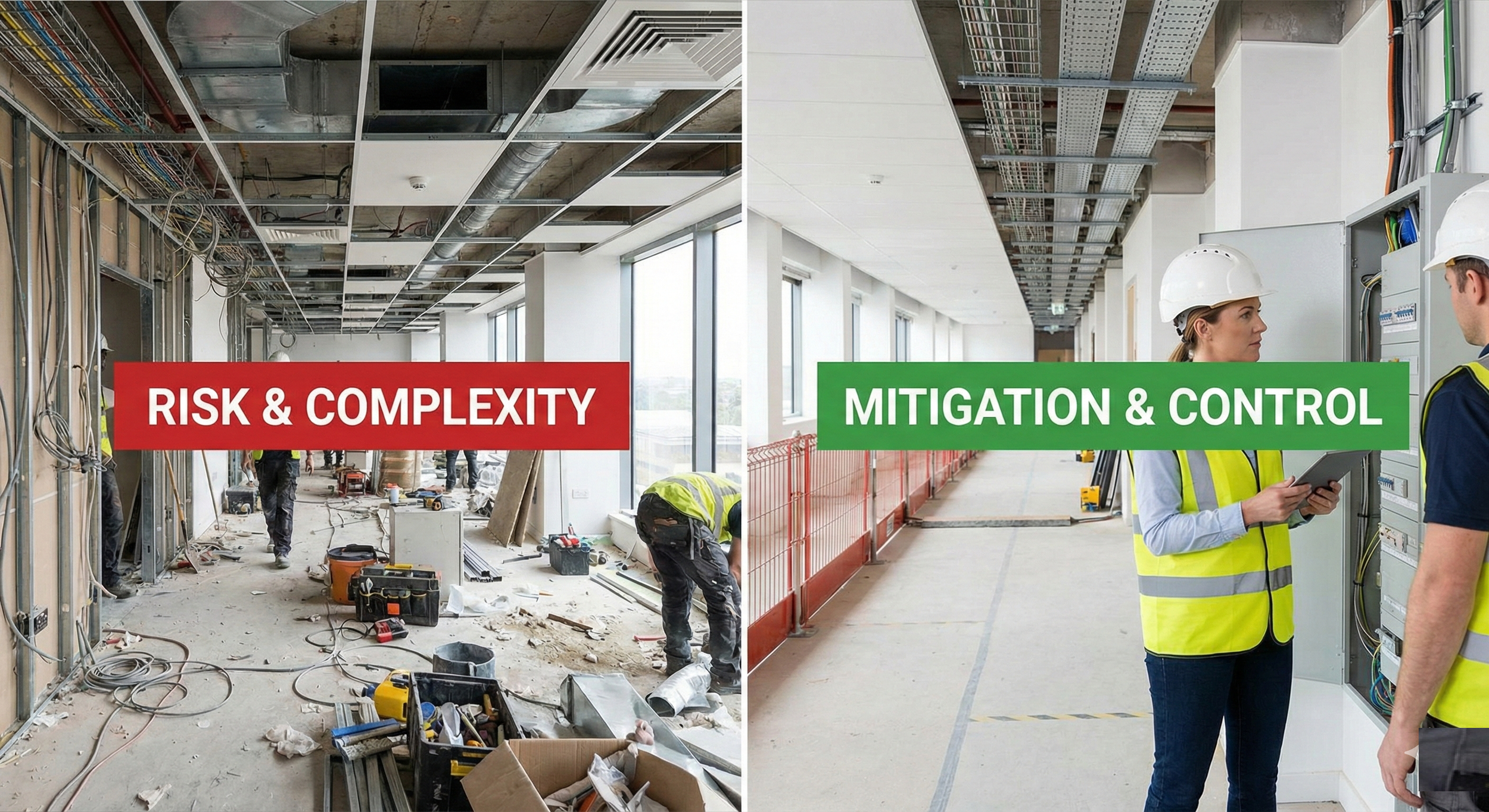
Challenge 1: Renovating Aging Buildings with Hidden Conditions
Many commercial properties across Cleveland were constructed decades ago. While these buildings offer structural character and prime locations, they often conceal risks behind walls and ceilings—outdated electrical systems, undocumented modifications, or hazardous materials such as asbestos.
Industry data shows that unforeseen site conditions are one of the leading causes of renovation cost overruns, contributing to 20–30% budget increases when not properly managed.
How Project Management Solves This:
A commercial renovation project manager initiates early investigative assessments, coordinates intrusive surveys where required, and works with consultants to identify risks before construction begins. When surprises do emerge—as they often do—the project manager evaluates options, controls change orders, and protects the overall budget and schedule.
Rather than allowing hidden conditions to derail progress, structured management turns uncertainty into informed decision-making.
Challenge 2: Maintaining Operations During Renovation
Unlike new construction, most commercial renovations must occur while facilities remain active. Hospitals must continue patient care. Office tenants expect uninterrupted access. Universities operate around fixed academic calendars.
Without careful sequencing, renovations can disrupt operations, damage stakeholder relationships, and lead to revenue loss. According to facilities management studies, unplanned downtime during renovation can cost organizations thousands of dollars per day in lost productivity and service impact.
How Project Management Solves This:
A commercial renovation project manager develops phased execution plans, coordinates after-hours work, and aligns construction schedules with operational priorities. Stakeholder communication becomes a managed process rather than an afterthought—ensuring that disruptions are anticipated, not discovered in real time.
This balance between construction progress and business continuity is one of the strongest indicators of professional project management.
Challenge 3: Cost Control in a Volatile Construction Market
Construction costs remain volatile due to labor shortages, material price fluctuations, and supply chain constraints. Without disciplined oversight, budgets can quickly spiral—especially when scope changes are introduced mid-project.
Studies from global consulting firms indicate that projects lacking formal cost governance are significantly more likely to exceed approved budgets.
How Project Management Solves This:
A commercial renovation project manager establishes cost controls from day one—tracking expenditures, validating contractor claims, and evaluating every change request against its business impact. This ensures that leadership retains visibility and control, rather than reacting to financial surprises.
Cost management is not about cutting corners—it is about making informed trade-offs that align with long-term asset performance.
Challenge 4: Navigating Permits, Codes, and Compliance
Cleveland commercial renovations must comply with a range of local, state, and federal regulations—building codes, fire safety standards, accessibility requirements, and sector-specific regulations for healthcare or education facilities.
Missed approvals or failed inspections can halt projects entirely.
How Project Management Solves This:
The project manager coordinates permitting strategies, aligns design documentation with regulatory requirements, and schedules inspections proactively. Compliance becomes a structured workflow rather than a last-minute hurdle.
This level of coordination significantly reduces delays and protects organizations from regulatory exposure.
Challenge 5: Stakeholder Misalignment and Communication Gaps
Renovations often involve internal leadership teams, external consultants, contractors, and end users—each with different priorities. Without a central communication structure, decisions become fragmented and accountability unclear.
How Project Management Solves This:
A commercial renovation project manager serves as the single source of truth—facilitating structured meetings, documenting decisions, and ensuring alignment across all stakeholders. This clarity reduces conflict, accelerates approvals, and keeps the project moving forward with confidence.
A Question to Consider
When renovation challenges arise—as they inevitably will—do you have a system in place to manage them proactively, or are you relying on reactive problem-solving?
The difference between those two approaches often defines the success of commercial renovations.
What to Look for in a Commercial Renovation Project Manager in Cleveland
Once organizations recognize the value of professional project management, the next question becomes more nuanced: how do you choose the right commercial renovation project manager—especially in a market like Cleveland?
At the consideration stage, decision-makers are not looking for promises. They are looking for signals of competence, credibility, and control. The following criteria help separate transactional oversight from true project leadership.
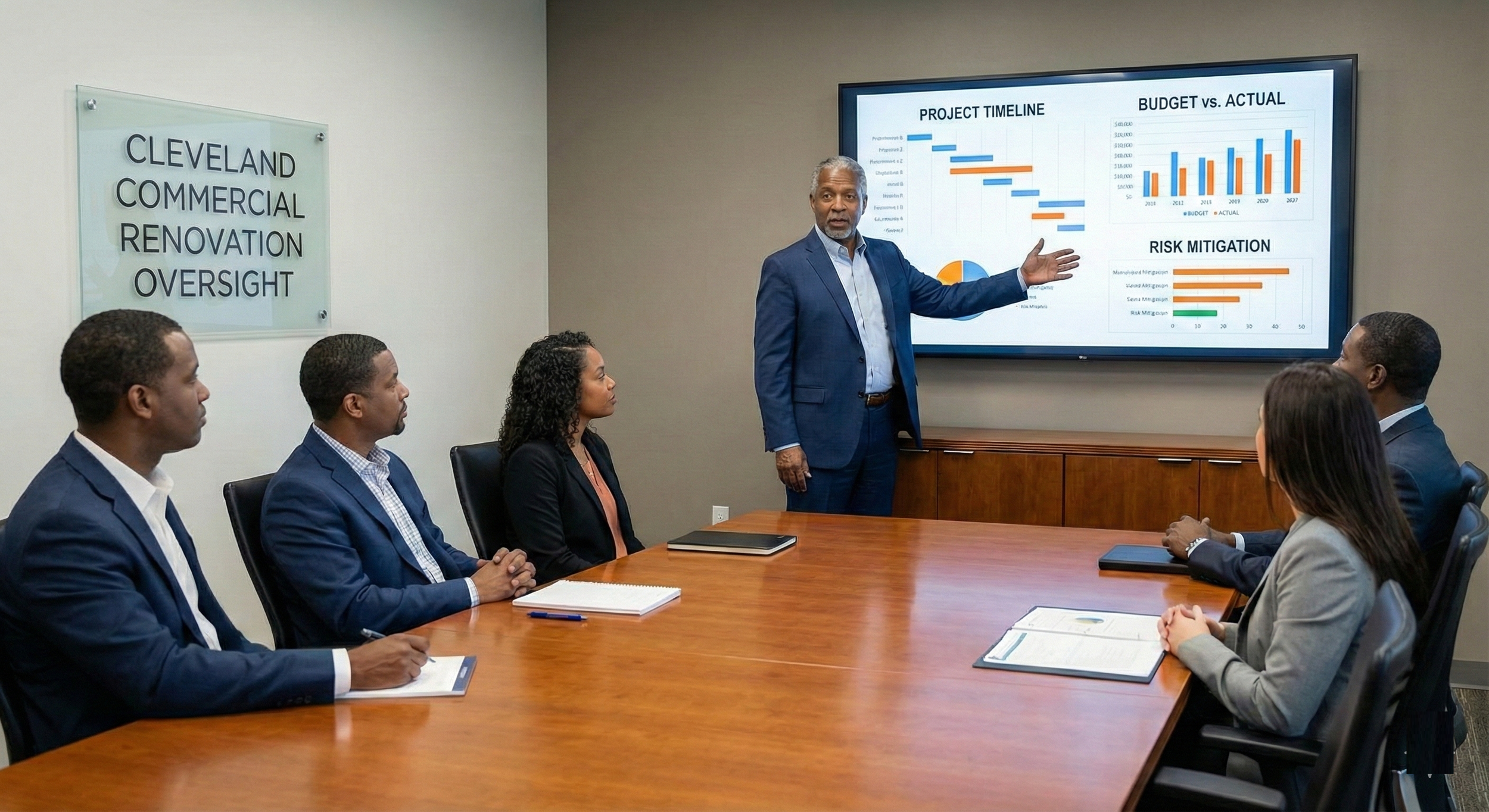
1. Proven Experience with Active Commercial Facilities
Commercial renovation project management is fundamentally different from managing new construction. In Cleveland, where renovations often take place in occupied and operational buildings, experience in live environments is non-negotiable.
A qualified project manager should demonstrate experience managing:
Renovations within healthcare, education, or commercial office facilities
Phased construction and after-hours work
Stakeholder coordination with minimal disruption
This experience reduces learning curves and protects operations from avoidable risk.
2. Local Market Knowledge and Regulatory Familiarity
Cleveland’s permitting processes, inspection protocols, and code enforcement requirements require local understanding. A project manager unfamiliar with regional expectations can unintentionally introduce delays or compliance risks.
Strong candidates bring:
Working knowledge of Cleveland-area authorities and approval processes
Relationships with local consultants and contractors
Familiarity with regional construction challenges, including older building stock
Local insight enables smoother execution and faster resolution of issues.
3. Structured Methodology, Not Ad-Hoc Oversight
Effective project management follows a defined methodology—covering planning, execution, monitoring, and closeout. Organizations should look for managers who rely on repeatable systems, not informal coordination.
Key indicators include:
Documented project plans and risk registers
Clear cost tracking and reporting structures
Formal change management processes
Regular progress reporting tied to measurable outcomes
Structure creates predictability—an essential asset during complex renovations.
4. Financial and Risk Management Capability
Commercial renovations involve significant capital investment. A capable project manager must understand not just construction, but also financial controls and risk mitigation.
Look for expertise in:
Budget development and cost forecasting
Evaluation of contractor pricing and change orders
Contingency planning and lifecycle cost considerations
This capability ensures that renovation decisions support both short-term delivery and long-term asset performance.
5. Communication, Transparency, and Accountability
Perhaps the most overlooked criterion is communication. Renovation success depends on timely information, clear accountability, and documented decisions.
An effective commercial renovation project manager:
Acts as a single point of accountability
Maintains transparent communication with leadership
Translates technical details into business-relevant insights
This level of clarity builds trust—and allows leadership to make informed decisions without being buried in technical complexity.
A Decision-Framing Question
When evaluating project management partners, it’s worth asking:
Are we selecting someone to manage construction tasks—or someone to protect our investment and operations from start to finish?
The answer often clarifies the right choice.
For organizations seeking structured, locally informed oversight, IMG provides commercial renovation project management tailored to complex facilities:
👉 Discover How IMG Supports Commercial Renovation Projects in Cleveland
Turning Commercial Renovation into Measurable Value Insights, ROI, and Next Steps
Commercial renovation is often viewed as a necessary disruption—something to endure in order to maintain or modernize a facility. Yet organizations that approach renovation strategically, with structured project management in place, experience a very different outcome.
Instead of disruption, they gain measurable value.
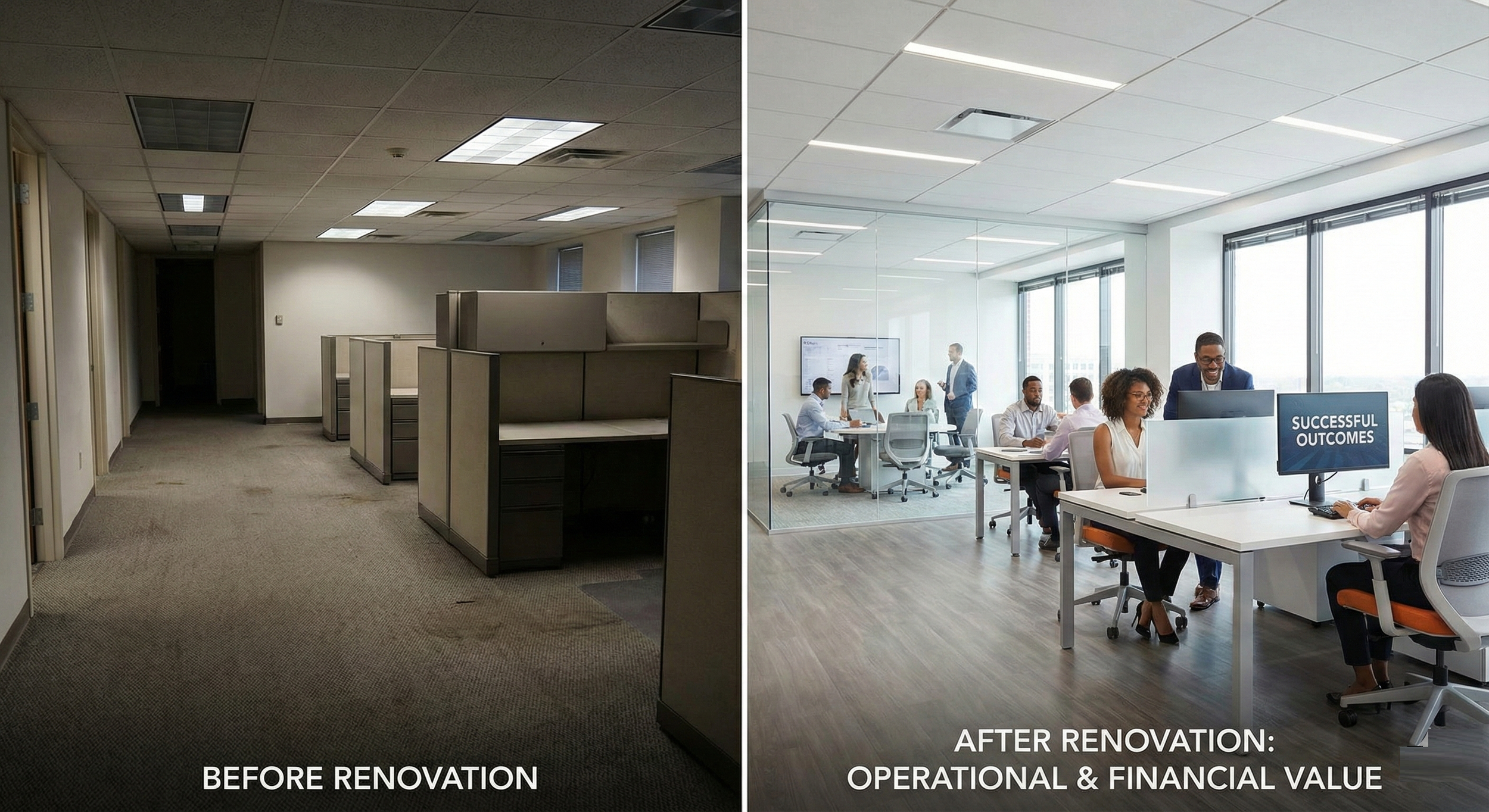
A Practical Scenario: From Risk to Control
Consider a multi-tenant commercial facility in the Cleveland metro area planning a phased interior renovation. The objectives were clear: modernize common areas, upgrade mechanical systems, and improve tenant satisfaction—without triggering vacancies or operational downtime.
Rather than managing the renovation internally, leadership engaged a commercial renovation project manager to oversee planning, coordination, and execution.
The result?
Construction phases were aligned with tenant usage patterns
Change requests were evaluated before costs escalated
Inspections passed without rework or delays
The project was delivered within the approved capital budget
More importantly, tenant retention improved, energy performance increased, and the facility’s long-term asset value was strengthened.
This is the difference between managing tasks and managing outcomes.
Understanding ROI Beyond Construction Completion
Return on investment in commercial renovation extends far beyond the ribbon-cutting moment. Industry data consistently shows that professionally managed renovations deliver value across multiple dimensions:
Cost efficiency: Formal cost controls reduce budget overruns by double-digit percentages
Operational continuity: Phased execution minimizes lost productivity and service disruption
Asset longevity: Proper planning improves lifecycle performance of building systems
Risk reduction: Structured oversight reduces compliance and liability exposure
In fact, facilities studies indicate that proactive project management can reduce total project cost variance by 15–25% compared to unmanaged or informally managed renovations.
These gains compound over time—especially for organizations managing multiple properties or large-scale facilities.
Why Early Engagement Matters
One of the most common mistakes organizations make is engaging project management too late—after design decisions are finalized or construction has already begun. At that point, opportunities to control scope, influence cost, and mitigate risk are already limited.
Early involvement allows a commercial renovation project manager to:
Align renovation goals with operational strategy
Identify risks before they become liabilities
Establish realistic schedules and budgets
Ensure design decisions support long-term performance
This proactive approach consistently leads to better outcomes.
Preparing for What Comes Next
If your organization is considering a commercial renovation in Cleveland—whether for a single facility or across multiple sites—the next step is not selecting finishes or approving drawings. The next step is clarifying who will own the outcome.
That means asking the right questions:
How will renovation impact daily operations?
What risks exist within the existing facility?
How will cost, schedule, and compliance be controlled?
Who is accountable when priorities conflict?
The answers to these questions define renovation success.
Final Thought
Commercial renovation does not have to feel uncertain or disruptive. With the right project management structure in place, it becomes a controlled, strategic investment—one that supports operational goals, financial performance, and long-term asset value.
If your next renovation could be delivered with fewer surprises, stronger cost control, and minimal disruption—what would that mean for your organization?
If you’re evaluating how to structure your next renovation for success, explore how IMG partners with organizations to deliver controlled, value-driven commercial renovation outcomes:
👉 Start a Conversation with IMG’s Commercial Project Management Team