
Why All-Electric Equipment Is No Longer Just an Environmental Choice—It's a Business One
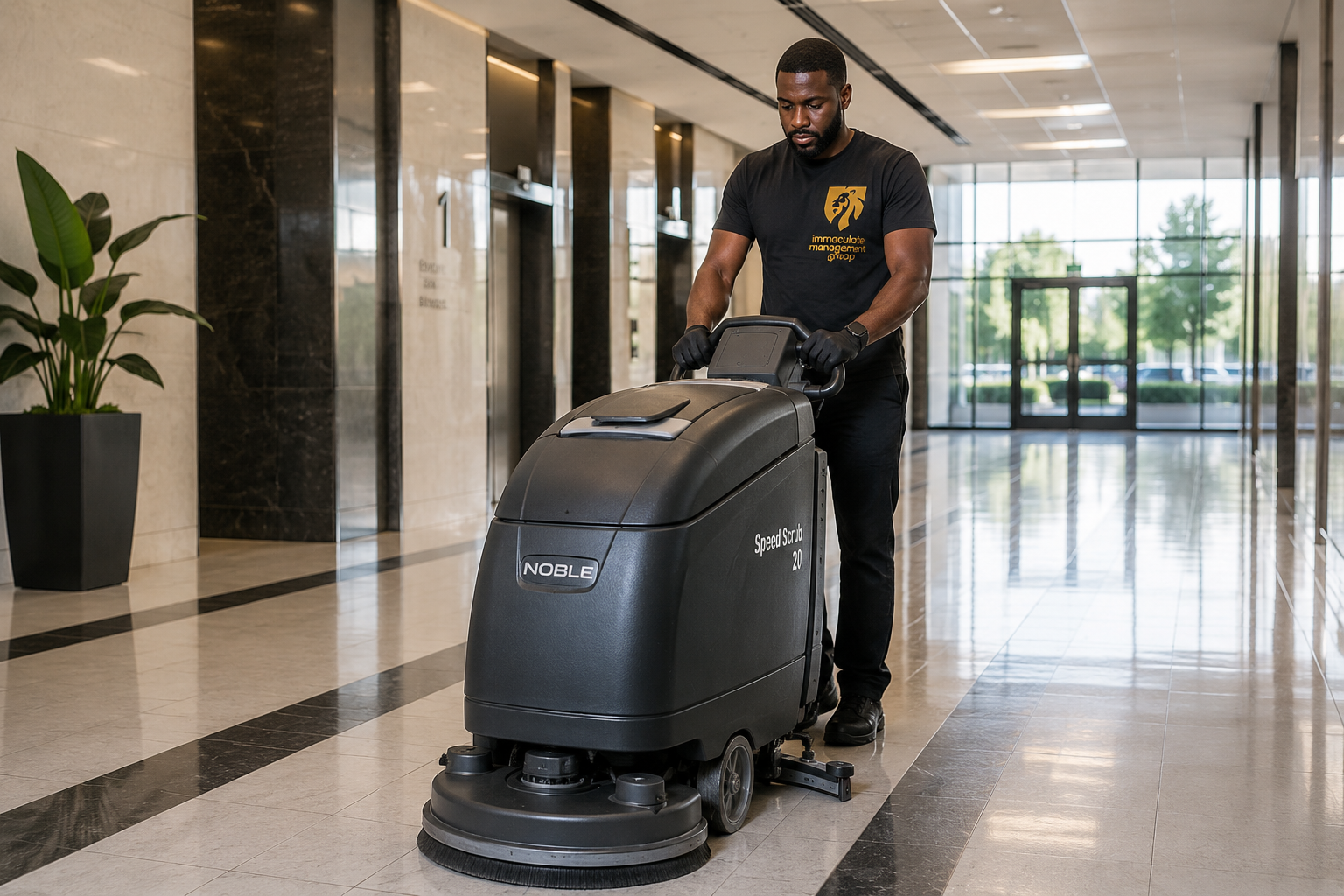
For most of the past decade, the conversation about all-electric equipment in commercial facility management lived in a specific corner of the room — the sustainability corner. It was framed as an environmental choice, a green initiative, something companies pursued when they wanted to demonstrate corporate responsibility or satisfy a tenant sustainability requirement.
That framing is now outdated. And for commercial property owners and facility managers in Northeast Ohio, the shift matters.
All-electric equipment has crossed a threshold. The business case — measured in operating costs, liability exposure, indoor air quality compliance, tenant satisfaction, and long-term asset value — now stands entirely on its own, independent of any environmental motivation. The companies and facilities that understood this early are already realizing the financial benefits. The ones still treating electrification as a values question rather than an operations question are leaving money on the table.
This post is about the business case — the specific, measurable, financial and operational reasons why all-electric equipment in commercial facility management is now a competitive advantage, not just a conscience choice.
What All-Electric Equipment Actually Means in a Facility Context
Before making the case, it is worth being precise about what we are talking about.
All-electric equipment in commercial facility management refers to the cleaning machines, floor care equipment, landscaping tools, and maintenance machinery that operate on battery power rather than gasoline, diesel, or propane. This includes commercial-grade battery-powered floor scrubbers, sweepers, and burnishers; electric-powered landscaping equipment including mowers, blowers, and trimmers; battery-operated pressure washers; and electric-powered utility vehicles used for grounds and facility maintenance.
This is not the same as consumer-grade battery tools. Commercial all-electric equipment operates at the power and runtime levels required to service large facilities — multi-floor office buildings, school campuses, healthcare facilities, industrial properties, and large commercial grounds. The technology has reached a point where runtime, power output, and durability are no longer meaningful objections to adoption in most commercial applications.
What has changed is that the cost structure of this equipment — both acquisition and operation — has reached a point where the business case closes regardless of any environmental premium.
The Business Case: Six Reasons All-Electric Is Now the Smarter Operational Choice
1. Operating Costs Are Measurably Lower
The most straightforward business argument for all-electric equipment is fuel cost elimination. Gasoline, diesel, and propane prices are volatile, regionally variable, and structurally trending upward over any multi-year horizon. A facility operation that runs gas-powered floor equipment, landscaping machinery, and utility vehicles is carrying fuel cost exposure that all-electric equipment eliminates entirely.
The comparison is not subtle. A commercial gas-powered ride-on floor scrubber operating 40 hours per week will consume meaningful fuel volumes over a year. The electricity required to charge an equivalent battery-powered unit for the same runtime costs a fraction of that figure at any current utility rate — including Ohio's commercial electricity rates, which remain among the more competitive in the region.
Across a facility management operation running multiple pieces of powered equipment, the fuel cost differential compounds quickly. For a facility management company servicing multiple commercial properties, the operating cost advantage of an all-electric fleet becomes a direct margin improvement that can be passed through to clients as a cost efficiency or retained as operational profit.
2. Maintenance Costs Drop Significantly
Internal combustion engines — gasoline, diesel, propane — have maintenance requirements that electric motors do not. Oil changes, fuel filter replacements, spark plug service, carburetor maintenance, exhaust system upkeep, and the general mechanical complexity of combustion systems all represent recurring cost and downtime that battery-powered equipment eliminates.
Electric motors have dramatically fewer moving parts than combustion engines. The primary maintenance requirements for battery-powered commercial equipment are battery management — ensuring batteries are properly charged, stored, and replaced at appropriate intervals — and general mechanical upkeep of the non-motor components. The reduction in scheduled maintenance frequency and unscheduled repair incidents translates directly to lower maintenance spend and higher equipment uptime.
For a facility management company, equipment uptime is a service delivery issue as much as a cost issue. A gas-powered floor scrubber that goes down for engine maintenance affects the service schedule for every property it serves. An all-electric fleet with fewer mechanical failure points maintains service continuity more reliably — which matters enormously to commercial property clients who depend on consistent facility performance.
3. Indoor Air Quality Compliance Is Becoming Non-Negotiable
This is the business argument that most facility managers and property owners are not yet fully accounting for — and it is one of the most consequential.
Gas and propane-powered equipment produces combustion emissions including carbon monoxide, nitrogen oxides, and particulate matter. When this equipment is operated indoors or in partially enclosed spaces — parking structures, building interiors, covered loading docks, indoor maintenance areas — those emissions affect the air quality of the building environment.
OSHA's indoor air quality standards and the General Duty Clause create clear employer liability exposure when indoor air quality is compromised by facility operations. Beyond OSHA, the EPA's indoor air quality guidelines and increasingly stringent state-level requirements are raising the compliance bar for commercial buildings across every sector.
All-electric equipment produces zero combustion emissions at the point of operation. There are no exhaust gases, no carbon monoxide risk, no particulate emissions from engine combustion. For facilities that use powered equipment indoors — which includes virtually every commercial building that uses floor care equipment — the transition to all-electric is a direct reduction in indoor air quality liability exposure.
For healthcare facilities, school buildings, and food service environments — three sectors where indoor air quality standards are particularly stringent and enforcement is active — all-electric equipment is not just a preference. It is increasingly the only defensible operational choice.

4. Noise Reduction Has Real Operational and Tenant Value
This is a benefit that does not show up on a balance sheet directly but has measurable impact on tenant satisfaction, lease retention, and building reputation.
Gas-powered commercial equipment is loud. A gas-powered ride-on floor scrubber, a propane burnisher, a gas-powered leaf blower operating near building entrances — these create noise levels that disrupt the work environment of tenants, affect the experience of building visitors, and in some cases create noise ordinance compliance issues in commercial and mixed-use zones.
Battery-powered commercial equipment operates at significantly lower decibel levels. The practical implications are significant: all-electric floor care equipment can be operated during business hours without disrupting tenant operations, allowing facility maintenance to happen during the day rather than requiring after-hours scheduling. All-electric landscaping equipment can be operated near building entrances and occupied areas without creating the noise impact of gas-powered alternatives.
For property managers focused on tenant satisfaction and retention, the ability to maintain a facility to a higher standard — more frequently, during business hours, without noise disruption — is a tangible differentiator. Tenants notice when building maintenance happens seamlessly around their operations rather than creating disruption. That experience affects lease renewal decisions in ways that are difficult to quantify but straightforward to observe.
5. Regulatory and Procurement Requirements Are Moving in One Direction
This is the forward-looking business argument — and it is the one that makes early adoption a competitive advantage rather than just a current-period cost decision.
Across the United States, regulatory requirements for commercial equipment emissions are tightening. California's Air Resources Board has already moved to restrict gas-powered commercial equipment in multiple categories, and those restrictions have historically been leading indicators of where federal and other state standards move over the following years. Ohio commercial property owners and facility managers who assume their operating environment will remain unchanged on equipment emissions are making a bet that the regulatory trajectory does not support.
Beyond regulatory requirements, procurement standards for institutional and government contracts are increasingly specifying low-emission or zero-emission equipment for facility services. For a facility management company pursuing public sector contracts, school district work, government building maintenance, or institutional clients with sustainability mandates — the ability to demonstrate an all-electric or predominantly electric fleet is becoming a competitive differentiator in the RFP process.
IMG's investment in all-electric equipment is not just an operational decision. It is a positioning decision — one that expands the range of clients and contracts available to the company as procurement standards continue to evolve.
6. Long-Term Asset Value and ESG Alignment
The final business argument is one that matters most to commercial real estate investors and institutional property owners — a growing portion of the Northeast Ohio commercial property market.
Environmental, Social, and Governance criteria are now embedded in the investment evaluation frameworks of institutional real estate investors, corporate tenants making location decisions, and lenders evaluating commercial property financing. A building that can demonstrate lower operational emissions, better indoor air quality management, and facility management practices aligned with ESG standards is a more attractive asset — for investors, for tenants, and for the debt markets that finance commercial real estate.
The facility management choices made at the operational level directly affect these assessments. A commercial property serviced by a facility management partner running all-electric equipment has a measurably different environmental footprint than one serviced by a company running a gas-powered fleet. In an environment where ESG credentials affect asset valuation, tenant attraction, and financing terms, that difference has real economic value.
What This Means for Commercial Property Owners in Northeast Ohio
The business case for all-electric equipment is not a future projection. It is a present reality — one that is already affecting operating costs, liability exposure, tenant satisfaction, and procurement competitiveness for commercial facilities across the region.
For commercial property owners evaluating their facility management relationships, the questions worth asking are straightforward: What equipment does your current facility management partner run? Is it gas-powered, propane-powered, or electric? What are the indoor air quality implications of that equipment in your building? And as regulatory standards continue to tighten and procurement requirements continue to evolve, is your facility management partner positioned to keep pace — or will you be managing a transition on your timeline?
For school administrators and healthcare facility directors — two sectors where indoor air quality standards are most stringent and the stakes of non-compliance are highest — the equipment question is not peripheral. It is central to the compliance picture.
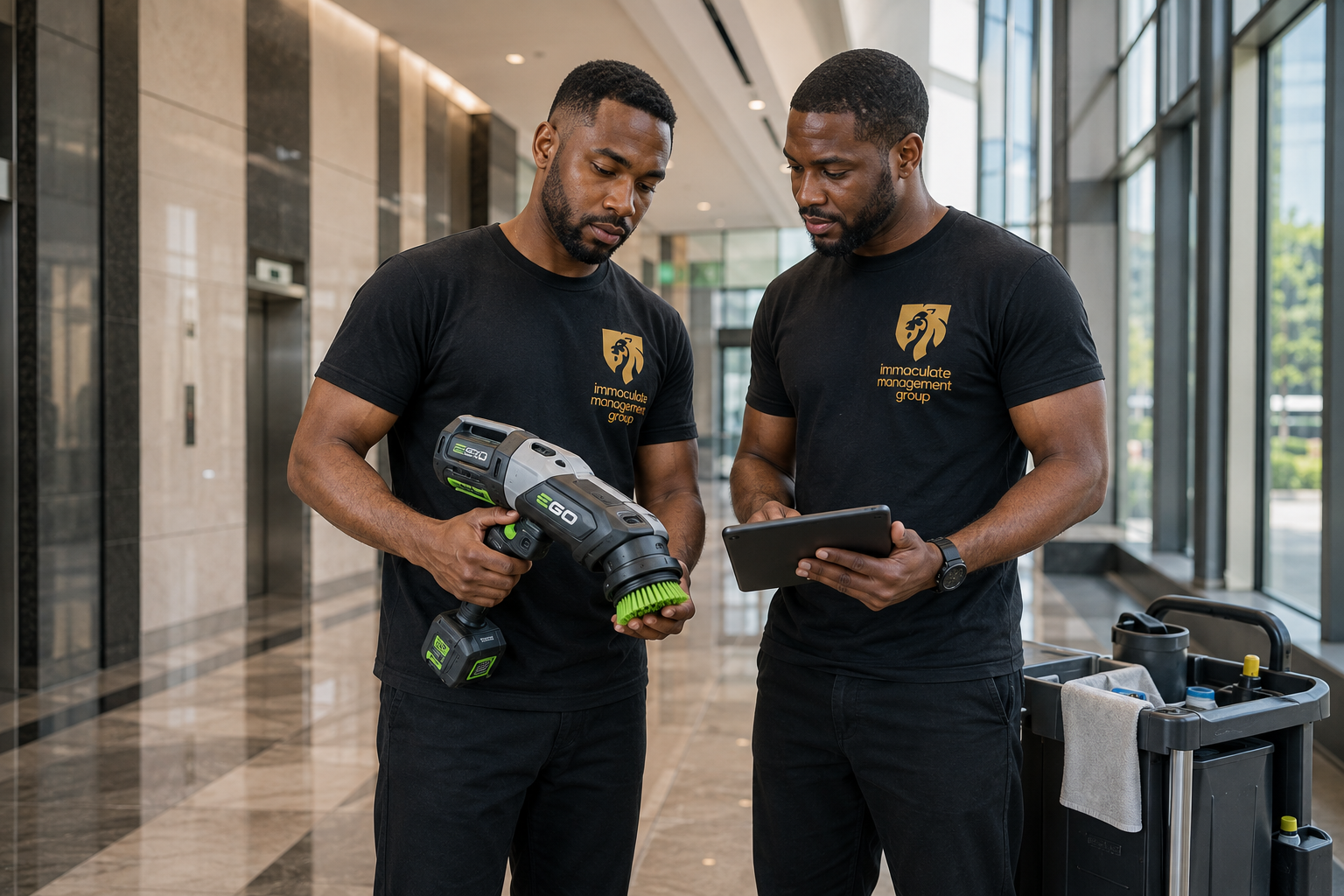
Immaculate Management Group has invested in all-electric equipment across our commercial cleaning, floor care, and landscaping operations because the business case is clear. Our clients in Northeast Ohio benefit from lower operational disruption, better indoor air quality performance, reduced noise impact, and a facility management partner whose equipment choices align with where regulatory and procurement standards are moving — not where they were five years ago.
The environmental benefits are real. But they are no longer the reason to make this choice. The business case stands entirely on its own.
Immaculate Management Group is a full-service facility management company serving commercial and educational properties across Northeast Ohio. Founded in 2011 by James Barnes, IMG is MBE and EDGE certified, OSHA compliant, and licensed and bonded. Learn more at theimggroup.com.