
How AI Is Transforming Facility Management—And Why Human Expertise Still Matters

A modern commercial office building during daylight, with subtle digital overlaysrepresenting data flows, sensors, and AI analytics. The building appears intelligent, with glowing lines connecting windows, HVAC units, and rooftop solar panels, symbolizing a smart facility ecosystem.
Entering the Age of Intelligent Facilities
The world of facility management is standing at a powerful intersection of innovation and human-driven purpose. As businesses, schools, hospitals, and commercial properties navigate the challenges of an evolving economy, aging infrastructure, rising operational costs, and increasing safety demands, one force is beginning to redefine how facilities operate: artificial intelligence. While AI has made its mark in industries like finance, healthcare, transportation, and digital services, its impact on facility operations is only now being widely understood. Yet its influence is profound. Modern buildings are no longer passive structures; they are becoming intelligent ecosystems capable of sensing, learning, predicting, and responding to the needs of the people within them.
Yet with all these advancements, one truth remains unchanged. Buildings still depend on human insight, empathy, judgment, leadership, and responsibility. AI is not arriving to replace the facility manager. Instead, it is amplifying their ability to protect, maintain, and enhance the structures entrusted to them. This understanding forms the heart of the new era of facility management: a world where AI and skilled human oversight work side by side.
This essay explores how AI is transforming the facility management industry and why human professionals remain irreplaceable. It examines how AI tools work, why the demand for trained facility managers is growing rather than shrinking, and what organizations must understand as they embrace the future of intelligent buildings.

An IMG facility manager standing in a mechanical room, holding a tablet displaying charts and analytics. The background shows pipes, HVAC units, and building equipment. Subtle digital overlays illustrate AI data points and alerts, indicating real-time monitoring.
The Rise of Artificial Intelligence in Facility Operations
Artificial intelligence has moved from a technological option to a strategic necessity for organizations that oversee physical assets. The demands placed on facility managers have increased significantly. Buildings today are larger, more complex, more regulated, and more heavily used than they were a decade ago. Occupants expect comfort, safety, efficiency, and swift response to any issue. At the same time, budgets are tighter, and owners seek better performance for lower cost.
AI enters this landscape as a solution that brings clarity where guesswork once existed. The technology relies on data collected from sensors, equipment logs, historical patterns, and environmental readings. From this information, AI systems can recognize early signs of equipment stress, safety risks, energy waste, or declining performance. Instead of waiting for a fault to appear, AI highlights trends before they become disruptions.
In plain terms, AI acts as a second set of eyes for the facility manager, watching thousands of micro-interactions within a building simultaneously. HVAC systems, lighting, energy consumption, water flow, air quality, occupancy patterns, and security movements all generate valuable data. AI analyzes these signals in real time and offers insights humans simply could not process at the same speed. This shift moves buildings away from reactive operations toward smarter, proactive, and more reliable performance.

Close-up of smart building sensors or IoT devices attached to HVAC ducts and lighting systems. Tiny digital icons float above the sensors, representing airflow, energy consumption, and connectivity, highlighting AI integration in real-time facility monitoring.
From Reactive to Predictive: How AI Changes Maintenance Forever
For decades, facility management was driven by two maintenance cultures. The first was reactive maintenance, which dominated most facility operations for much of the twentieth century. Something would break, energy costs would spike unexpectedly, equipment would fail, or a safety hazard would appear—and only then would action be taken. The second approach was preventive maintenance, where teams inspected equipment at scheduled intervals. This improved stability but still lacked precision, as many inspections occurred when equipment was functioning normally, and true issues were sometimes missed between scheduled checks.
AI introduces a fundamentally different model known as predictive maintenance. In this approach, sensors continuously gather information about the building’s equipment. Patterns such as vibration changes, temperature variations, unusual noise levels, energy fluctuations, declining performance, or unexpected pressure shifts are detected automatically. Instead of waiting for a failure, AI recognizes the early signs and alerts the facility team that the equipment needs attention.
This shift has powerful implications. Predictive maintenance reduces downtime, decreases repair costs, extends the lifespan of equipment, enhances safety, and dramatically improves planning. By preventing catastrophic failures, AI helps organizations avoid emergency shutdowns, unplanned expenses, and unsafe working conditions. It also empowers facility managers to make informed decisions backed by solid data rather than assumptions.
In many ways, predictive maintenance is becoming the backbone of modern facility management. Organizations that embrace it are able to plan more intelligently, operate more efficiently, and create more secure environments for their occupants.

A dashboard showing equipment performance trends with line graphs, bar charts, and alert indicators. The interface is sleek and modern, representing predictive analytics for HVAC, energy systems, and machinery. A soft glow around key alerts emphasizes AI-driven early detection.
Why Human Judgment Becomes More Valuable in an AI-Driven World
It is tempting to imagine AI as a force that operates buildings independently, eliminating the need for human professionals. But this idea misunderstands both the capabilities and limitations of artificial intelligence. Buildings are not purely mechanical spaces. They are environments created for people, and people bring complexity that no algorithm can fully capture.
Human oversight remains essential for several reasons. The first is the reality that buildings house human occupants whose comfort, safety, and emotional state cannot be measured purely by sensors. A spike in air temperature might signal discomfort, but only a facility professional can interpret how occupants respond, whether adjustments are needed, and what solutions will be most effective.
Another limitation of AI is its inability to understand context. Artificial intelligence may detect an anomaly, but it cannot always determine the environment that produced it. A sudden rise in occupancy might be misread as a security threat when it is simply a scheduled event. A vibration in equipment could be caused by external weather conditions rather than mechanical decline. Human interpretation is the bridge between data and wise decision-making.
Customer relations also depend heavily on the human element. Facility management is a relationship-driven profession where trust, communication, negotiation, and reassurance are essential. When an issue arises, clients turn to real people for explanations, solutions, and support. AI can provide information but cannot provide confidence.
Ethical decisions, safety judgments, and emergency responses rely entirely on human leadership. When a system fails or an unexpected hazard emerges, the responsibility for protecting lives and assets cannot be handed off to an algorithm. Humans remain the accountable decision-makers.
Finally, AI systems are not infallible. They can misinterpret data, miss rare patterns, or produce false alerts. Skilled facility managers must evaluate AI recommendations, confirm their accuracy, and choose the appropriate response. Rather than reducing human involvement, AI elevates the value of trained professionals who understand how to balance digital insights with real-world experience.

An IMG facility manager speaking with building occupants in a lobby, gesturing to explain a solution. A tablet in the manager’s hand displays analytics and graphs subtly, showing AI insights supporting decision-making. The environment is professional and well-lit, emphasizing collaboration.
The Technologies Shaping the Future of Intelligent Facilities
The transformation happening in facility management is driven by a combination of technologies working together. Artificial intelligence is the engine, but sensors, automation systems, advanced security tools, and digital building models serve as its supporting framework. These components interact continuously to give buildings awareness and responsiveness.
Smart sensors, often referred to as IoT devices, collect real-time data about temperature, humidity, air quality, energy consumption, water movement, and occupancy patterns. This information becomes the raw material AI uses to identify issues early.
Digital twins, or virtual replicas of physical buildings, allow facility managers to simulate potential changes, test upgrades, and analyze performance without disturbing operations. These models are becoming vital in long-term planning and energy optimization.
AI-powered security systems introduce another layer of intelligence by recognizing unusual activity, predicting potential threats, and enhancing access control. Instead of relying exclusively on human monitoring, these systems continuously analyze patterns to flag concerns before they escalate.
Energy management platforms driven by AI analyze how and when buildings consume power. They adjust heating, cooling, and lighting in ways that balance comfort with efficiency. This results in lower utility costs, reduced carbon impact, and more stable building environments.
Finally, workflow automation systems powered by artificial intelligence streamline the way tasks are initiated, tracked, and completed. Work orders are generated automatically, assigned based on skill and availability, and followed up without manual intervention. This reduces delays and increases accountability across all levels of operations.
Each of these tools plays a role in creating a building that can think, respond, and adapt—but always with a human professional guiding, overseeing, and interpreting the results.

A digital twin representation of a building. The building appears in 3D, with structural outlines, floor plans, and colored overlays showing energy use, occupancy, and sensor data. The scene conveys simulation, analytics, and AI-driven planning in facility management.
AI and the Expansion of Safety in Modern Facilities
Safety is the foundation of every well-managed building, and AI has become one of the most powerful tools for protecting occupants and assets. Intelligent systems detect potential hazards long before they become active threats. Whether it is a leaking pipe, an overheating boiler, declining air quality, or unauthorized access, AI systems monitor continuously and respond immediately.
Imagine a scenario where a boiler in a commercial building begins to overheat at dawn. Historically, this issue might go unnoticed until staff arrived later in the morning, by which time significant damage could have occurred. In an AI-driven facility, sensors detect the abnormal heat, AI recognizes the risk, an automatic shutdown is triggered, and facility managers are alerted instantly. A work order is generated, the incident is logged, and maintenance teams are notified—all before occupants arrive.
This is the new standard of proactive safety. Buildings equipped with AI minimize emergencies, reduce human error, and create a more predictable environment. Increased monitoring leads to fewer accidents, fewer disruptions, and greater peace of mind for building owners and occupants.
Yet, even with these advancements, humans remain central. AI may generate alerts, but it is the facility manager who evaluates the risk, contacts the necessary teams, communicates with stakeholders, and ensures that corrective action is executed properly.
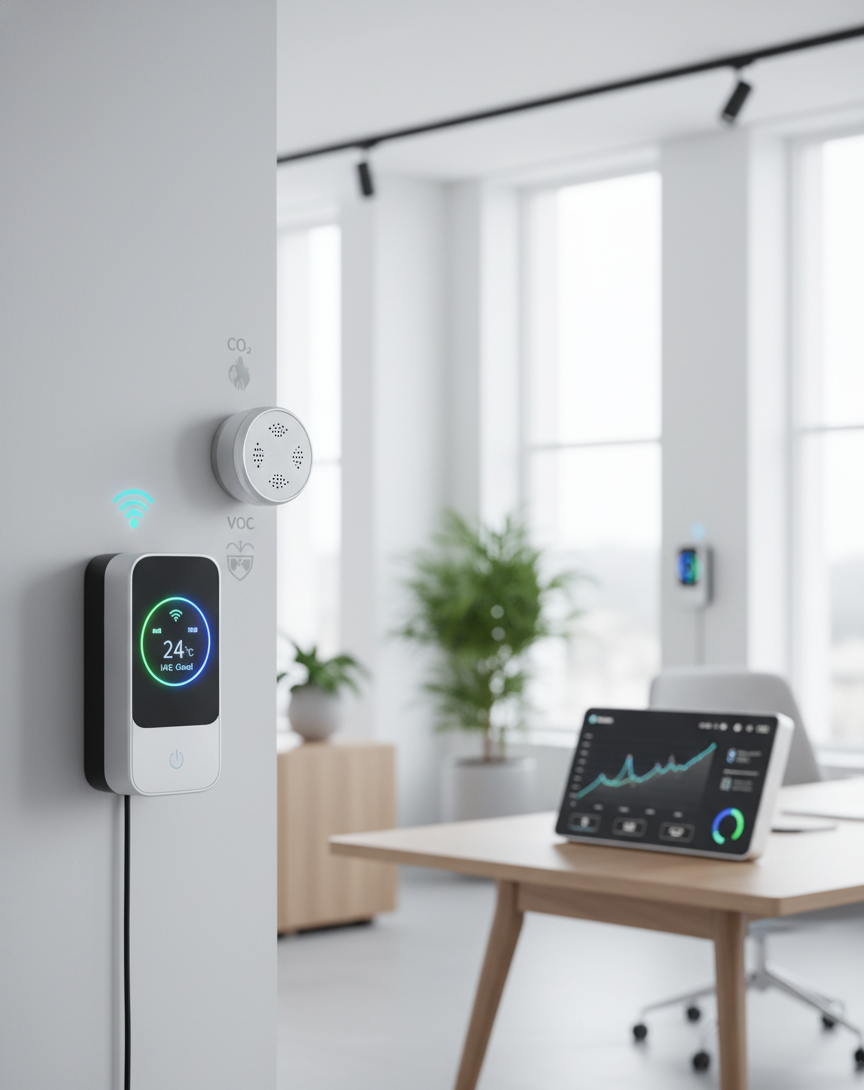
Indoor environmental sensors measuring air quality, temperature, and humidity in a clean office space. Subtle alerts and green/red indicators float near the sensors, representing AI monitoring and proactive safety measures.
The Human-Centered Facility Manager in a Digital World
As AI becomes more integrated into facility operations, the role of the facility manager is transforming into something more strategic, analytical, and leadership-driven. Rather than focusing solely on mechanical tasks, today’s facility professionals are becoming data interpreters, communicators, planners, and decision-makers.
They oversee the digital systems that run the building, interpret analytics, guide sustainability initiatives, prioritize repairs, manage vendors, and nurture relationships with tenants and owners. Their ability to think critically, adapt quickly, and lead confidently becomes even more essential as technology grows more advanced.
This evolution is not replacing humans. It is enhancing their career paths. The facility managers who thrive in this new landscape are those who embrace technology, understand its capabilities, and use it to amplify the quality of service they deliver. AI does not diminish the importance of human expertise—it elevates it.

A thoughtful facility manager reflecting on daily operations inside a bright, well-organized workspace, showcasing the intentional planning and strategic oversight that drive modern facility performance.
How Immaculate Management Group Bridges AI Technology with Human Excellence
At Immaculate Management Group, our philosophy is simple. Technology strengthens our work, but human dedication defines it. We integrate AI into our maintenance strategies, energy optimization plans, security monitoring, and operational workflows. Yet every decision is guided by trained facility managers who understand the needs of the building and the expectations of the people who use it.
Our approach is built on the balance of intelligent systems and expert oversight. AI helps us identify potential risks early, streamline tasks, lower operational costs, and enhance building comfort. Our team adds the judgment, professionalism, communication, and reliability that no algorithm can replicate.
This is the future of facility management: a partnership that brings out the best of human skill and digital innovation.

A wide, bright atrium of a modern corporate office building featuring white marble floors, indoor trees, and professionals walking or sitting in lounge areas.
The Future Belongs to AI-Empowered Facility Managers
As the facility management industry moves deeper into the age of artificial intelligence, one truth becomes evident. AI is not here to replace facility managers. It is here to empower them. Buildings may become smarter, but they still require human stewardship. Systems may become more automated, but they still rely on human interpretation. Data may become more abundant, but it still demands human wisdom.
The future belongs to facility teams who embrace technology, not fear it. It belongs to organizations that understand the balance between intelligent automation and human guidance. And it belongs to individuals who recognize that artificial intelligence is most powerful when paired with real-life experience, empathy, and leadership.
In this new era, the most valuable facility manager is not the one who competes with AI, but the one who uses it to elevate their performance, deepen their insight, and deliver excellence every single day.
This is the future Immaculate Management Group is building—one intelligent facility at a time.